
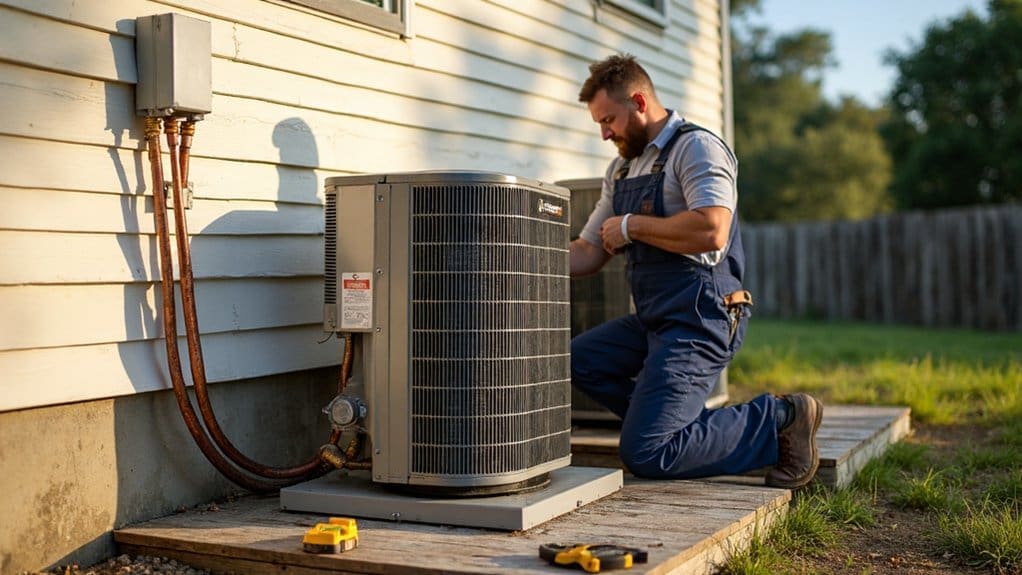
You’ll need to conduct an ACCA Manual J load calculation to determine proper AC unit sizing, then have EPA-certified technicians safely recover refrigerant from your old system. Next, you’ll prepare the installation site to meet building codes, position the new condenser unit on a level pad with adequate clearances, and connect refrigerant lines through precise brazing techniques. Finally, you’ll test system performance and calibrate thermostat operation to guarantee effective functionality and code compliance throughout the thorough replacement process.
Key Takeaways
- Conduct ACCA Manual J load calculation to determine proper AC unit size based on home’s square footage, insulation, and occupancy patterns.
- EPA-certified technicians must safely recover all refrigerant from the old system and remove components following environmental regulations.
- Verify electrical connections, voltage requirements, and clearances around installation site to meet current building codes and manufacturer specifications.
- Position outdoor condenser unit on level pad and braze all refrigerant line connections to create a sealed system.
- Test system performance parameters, thermostat operation, and demonstrate all features to homeowner after installation completion.
Assessing Your Home’s Cooling Needs and System Requirements
Before replacing your central air conditioning system, you must conduct a thorough assessment of your home’s cooling requirements through an ACCA Manual J load calculation. This precise calculation determines the appropriate AC unit size by analyzing critical factors including insulation levels, window specifications, square footage, and occupancy patterns.
Your replacement unit must be properly sized according to tonnage and BTU ratings. Undersized systems can’t adequately cool your home, while oversized units create humidity problems and inefficient cycling. You’ll need to evaluate your existing ductwork capacity and condition, as modifications may be required for satisfactory performance.
Consider SEER ratings during selection, as federal regulations mandate minimum SEER 13 efficiency. Factor in electrical system compatibility and permit requirements when planning your conditioning system replacement to guarantee code compliance and safe operation.
Removing the Old Air Conditioning System
The removal of your existing central air conditioning system requires strict adherence to EPA regulations and safety protocols to prevent environmental contamination and property damage. EPA-certified technicians must properly recover all refrigerant from your old system before any component removal begins. Your home’s surrounding areas receive protective coverings to prevent debris damage during the extraction process.
The outdoor unit removal includes replacing the concrete pad beneath it to guarantee proper foundation for your new system. Inside your home, technicians disconnect the evaporator coil from all refrigerant lines and electrical connections. Existing ductwork undergoes thorough inspection for leaks or sealing deficiencies that could compromise your new system’s efficiency. This systematic approach confirms code-compliant removal while preparing your home for seamless installation of the replacement equipment.
Preparing the Installation Site and Components
Following the complete removal of your old system, proper site preparation forms the foundation for your new central air conditioning installation’s long-term performance and reliability. You’ll need to guarantee your installation site preparation meets current building codes and manufacturer specifications. Experienced technicians should inspect electrical connections, verify proper voltage requirements, and confirm adequate clearances around the outdoor unit location.
Next, you’ll prepare key components for assembly. Check refrigerant lines for damage, confirm proper insulation integrity, and verify compatible fittings. Your ductwork connections must align precisely with the new unit’s specifications. Clean all mounting surfaces thoroughly and apply appropriate sealants where required. Finally, stage all installation hardware, electrical components, and safety equipment within easy reach to maintain efficient workflow throughout the installation process.
Installing the Outdoor Condenser Unit
Positioning your outdoor condenser unit correctly establishes the foundation for efficient system operation and long-term reliability. Place the unit on a level composite pad, ensuring adequate clearances from windows, doors, and surrounding structures per manufacturer specifications. Connect the condenser unit to your indoor evaporator coil using the line set, which must be properly sized for your system’s refrigerant requirements.
Braze all connections to the service valves to create a completely sealed refrigerant system. Install the filter dryer near the expansion valve to eliminate moisture and contaminants that could compromise system performance. Throughout installation, carefully inspect the condenser unit for any shipping damage or installation-related issues. Proper positioning and secure connections are critical for ideal heat rejection and system longevity.
Setting Up the Indoor Evaporator Coil
With your outdoor condenser unit properly positioned and connected, focus shifts to installing the indoor evaporator coil within your furnace plenum. You’ll position the coil in the plenum section where air enters and exits the system. For uncased coils, install mounting rails to secure appropriate positioning and support. Maintain meticulous sealing between the evaporator coil and existing sheet metal plenum to prevent air leakage and preserve system efficiency. Pay careful attention to air flow direction and drain pan clearance during installation—improper positioning compromises cooling performance and creates drainage issues. Once positioned, connect and seal the coil to the remaining HVAC components. This critical step completes the indoor cooling cycle integration, ensuring ideal refrigerant flow and temperature control throughout your home’s ductwork system.
Connecting Refrigerant Lines and Electrical Components
How do you establish the critical connections that complete your central air conditioning system’s refrigerant and electrical circuits? You’ll connect copper pipes forming the refrigerant lines between your indoor evaporator coil and outdoor condenser unit through proper brazing techniques. This creates sealed, leak-free connections essential for system integrity. Your electrical connections require installing a disconnect switch near the outdoor unit for safe maintenance access, while connecting the indoor unit to your home’s electrical system at the furnace or air handler.
| Connection Type | Safety Requirement | Consequence of Failure |
|---|---|---|
| Refrigerant Lines | Proper brazing seal | Costly refrigerant leaks |
| Electrical Disconnect | Code-compliant installation | Service safety hazards |
| Indoor Electrical | Manufacturer specifications | System malfunction |
| Line Set Sizing | Precise calculations | Reduced efficiency |
Follow strict HVAC protocols when handling refrigerants and making electrical connections to meet safety codes.
Testing System Performance and Thermostat Operation
After completing all refrigerant and electrical connections, you must systematically test your new central air conditioning system to ascertain proper operation across all components. Begin by testing refrigerant flow and initiating system startup procedures to guarantee all mechanical functions operate correctly. Evaluate the complete sequence of operation, verifying your air handler cycles properly through all phases. Check critical system parameters including refrigerant pressures, operating temperatures, and airflow measurements to assess overall performance against manufacturer specifications. Test thermostat functionality by cycling through different temperature settings and operating modes. If you’re installing a new thermostat, mount it according to code requirements and demonstrate all features to the homeowner. Complete system testing confirms your air conditioning system is fully operational and ready for reliable service.
Conclusion
You’ve successfully completed your central air conditioning replacement following proper installation protocols. Your new system operates like a well-orchestrated symphony, with each component working in precise harmony. You’ve guaranteed code compliance through proper refrigerant handling, electrical connections, and system testing. Don’t forget to schedule regular maintenance intervals and keep your warranty documentation accessible. Your professionally installed system will now provide efficient, reliable cooling while maintaining ideal safety standards and energy performance for years ahead.