
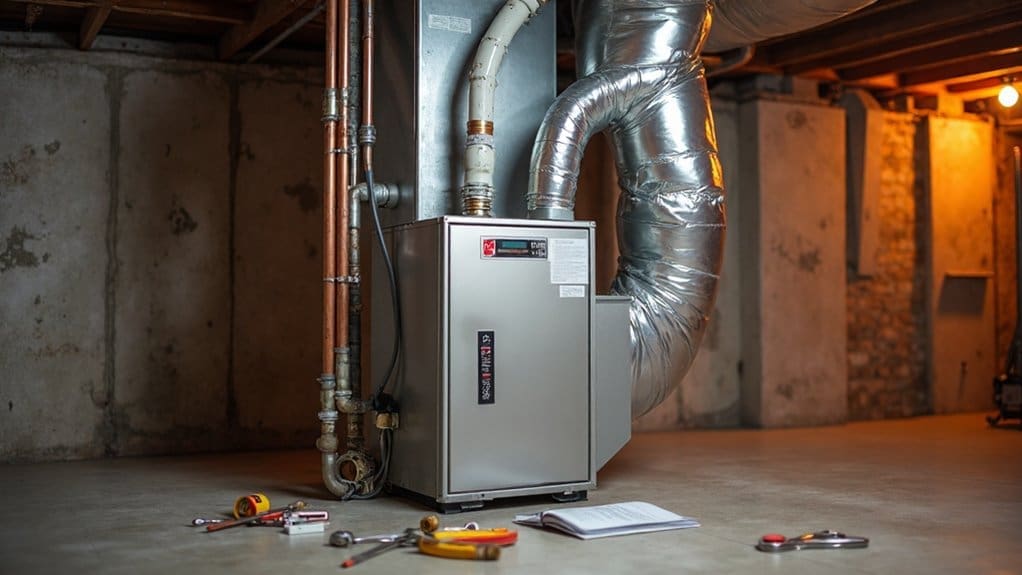
You’ll need precise Manual J load calculations for St. Louis’s humid continental climate, which creates extreme thermal loads from sub-24°F winters to 90°F+ summers. Replace your furnace if it’s 15-20 years old, shows performance degradation, or repair costs exceed 50% of replacement value. Choose gas furnaces with 95% AFUE ratings for maximum efficiency and $350 annual savings. Verify your contractor maintains EPA certification, state licensing, and liability insurance for safe installation. This thorough assessment guarantees proper system sizing and long-term performance maximization.
Key Takeaways
- Replace your furnace when it’s 15-20 years old, showing performance issues, or repair costs exceed 50% of replacement value.
- Choose gas furnaces for most St. Louis homes, or consider heat pumps for year-round efficiency in the continental climate.
- Require professional Manual J load calculations considering home size, insulation, and local climate conditions for proper furnace sizing.
- Select ENERGY STAR certified units with minimum 95% AFUE ratings to save $350 annually on energy costs.
- Hire EPA-certified, state-licensed contractors with liability insurance and proven expertise for safe, compliant furnace installation.
Understanding St. Louis Climate and Your Heating Needs
The St. Louis region’s humid continental climate demands a robust HVAC system capable of handling extreme thermal loads. Your heating system must accommodate temperature swings from sub-24°F winter lows to 90°F+ summer peaks. This 114-degree differential requires precise BTU calculations for proper furnace sizing. Annual snowfall averaging 18 inches creates additional heat loss through infiltration and structural thermal bridging. Professional load calculations account for these climate-specific variables when specifying New equipment. Energy efficiency becomes critical given extended heating seasons and fluctuating fuel costs. Your furnace must maintain consistent indoor temperatures while minimizing operational costs. Safety considerations include proper combustion air supply and venting systems designed for St. Louis’s humidity levels. Climate-appropriate equipment selection guarantees optimal performance, longevity, and code compliance throughout the region’s challenging weather patterns.
Signs Your Furnace Needs Replacement
Recognizing critical furnace failure indicators prevents costly emergency breakdowns and protects your family’s safety during St. Louis’s harsh winter months. Your old furnace displays multiple warning signs when replacement becomes necessary. Age remains the primary factor—heating systems should be replaced every 15-20 years regardless of apparent functionality. Performance degradation includes inconsistent temperatures, frequent cycling, and increased energy consumption indicating your unit’s becoming less efficient.
Carbon monoxide risks escalate with aging heat exchangers, making immediate replacement vital for occupant safety. When furnace repair costs exceed 50% of replacement value, economics favor new installation. Yellow pilot light flames, excessive dust circulation, and unusual operational noises signal internal component failure. Professional HVAC technicians can assess whether you need to replace your entire heating system or if targeted repairs remain viable for your specific situation.
Types of Furnaces Available for St. Louis Homes
Once you’ve determined replacement becomes necessary, selecting the appropriate furnace type for your St. Louis home requires careful consideration of fuel availability, efficiency ratings, and installation requirements.
Available Furnace Options:
- Gas furnaces – Most prevalent choice offering superior efficiency and reduced operating costs when gas lines are accessible to your property.
- Electric furnaces – Ideal for all-electric homes, delivering clean heating without requiring gas line connections or combustion safety concerns.
- Oil furnaces – Cost-effective alternative for properties lacking natural gas access, though less common in the St. Louis market.
- Heat pumps (dual-fuel systems) – Combine gas heating with electric cooling capabilities for year-round climate control efficiency.
Furnaces run most efficiently when AFUE ratings exceed 90%, greatly reducing energy consumption and operational expenses.
Calculating the Right Furnace Size for Your Home
After selecting your preferred furnace type, determining the correct unit size becomes crucial for ideal system performance and energy efficiency. HVAC professionals utilize Manual J load calculations to assess your home square footage, insulation quality, climate conditions, and existing energy efficiency measures. This thorough analysis guarantees optimal furnace size selection for your specific installation requirements.
Undersized units won’t adequately heat your home, forcing continuous operation and compromising comfort levels. Conversely, oversized furnaces create short-cycling conditions, increasing operational costs by 30% while accelerating component wear. These improperly sized systems waste energy and significantly reduce equipment lifespan.
Professional load calculations consider heat loss factors, ductwork efficiency, and local climate data. Properly sized systems maintain consistent temperatures, minimize utility expenses, and maximize equipment longevity. Never rely on square footage alone—accurate sizing requires detailed engineering analysis.
Energy Efficiency Ratings and Cost Savings
When evaluating furnace replacement options, understanding Annual Fuel Utilization Efficiency (AFUE) ratings becomes indispensable for maximizing long-term cost savings and system performance. Energy efficiency ratings directly impact your heating and cooling services costs, making proper HVAC system selection pivotal for St. Louis homeowners.
Key efficiency considerations for furnace installation services:
- ENERGY STAR certified units maintain 95% minimum AFUE ratings – delivering superior energy efficiency ratings compared to standard models
- Upgrading from 80% to 95% AFUE saves $350 annually – substantial cost savings for local homeowners
- Installation costs recover within 5-10 years – installing a new furnace becomes cost-effective through reduced utility expenses
- Home size and insulation affect efficiency requirements – proper sizing ensures ideal performance and safety
High-efficiency furnace installation represents a strategic investment, reducing environmental impact while delivering measurable cost savings throughout your HVAC system’s operational lifespan.
Furnace Installation Process and Timeline
Professional furnace installation requires meticulous coordination between certified HVAC technicians and homeowners to guarantee code compliance, system safety, and excellent performance.
The installation and replacement process typically spans 4-18 hours, depending on ductwork modifications and natural gas line requirements. Professional furnace installation involves precise positioning, secure utility connections, and thorough ventilation system integration.
| Installation Phase | Duration | Critical Components |
|---|---|---|
| Unit Positioning | 2-4 hours | Furnaces placement, leveling |
| Utility Connections | 3-6 hours | Natural gas lines, electrical wiring |
| System Integration | 2-8 hours | Ductwork sealing, air distribution |
Heating and air conditioning contractors must hold certifications from NATE, ASHRAE, or NPGA. The cost to install increases with electrical modifications and gas line extensions. Payment discussions should occur before work commences, with tipping $10-20 per technician recommended for exceptional service.
Replacement Costs and Financing Options
Beyond the technical complexities of installation, homeowners must navigate the substantial financial investment required for furnace replacement. Understanding how much does it cost and available financing options guarantees your new furnace operates efficiently without compromising your budget.
St. Louis Furnace Replacement Cost Factors:
- Basic unit replacement: $2,000-$5,400 for standard systems, $3,300-$6,900 for high-efficiency models
- Existing ductwork modifications: Additional $1,800-$6,600 when structural changes are required
- Labor rates: Professional services typically account for 30-40% of total project costs
- Combined system upgrades: $4,000-$10,000 for furnace and air conditioner replacement
Multiple financing options provide accessible pathways: manufacturer payment plans, home improvement loans, utility rebates, and government tax credits. Reliable service providers often partner with financing companies to streamline approval processes, verifying your heating system installation proceeds without financial delays.
Choosing a Qualified Furnace Installation Contractor
The success of your furnace installation hinges on selecting a contractor who possesses proper licensing, bonding, and extensive insurance coverage. When evaluating HVAC services in St Louis, you’ll need an experienced team that demonstrates proven expertise in residential heating systems.
| Qualification | Verification Method | Critical Importance |
|---|---|---|
| EPA Certification | Request certificate number | Refrigerant handling compliance |
| State Licensing | Check regulatory database | Legal operation authorization |
| Liability Insurance | Demand proof of coverage | Property damage protection |
A professional HVAC technician should provide exhaustive documentation of their credentials before beginning work. The company offers repair services alongside installation capabilities, ensuring long-term system support. Louis homeowners must prioritize contractors who maintain current certifications and follow safety protocols during furnace installation procedures.
Maintenance Tips for Your New Furnace
Once your new furnace system becomes operational, you’ll need to establish a rigorous maintenance protocol to maximize equipment longevity and maintain warranty compliance. Proper maintenance guarantees optimal heat distribution and protects your investment, whether you’ve installed a traditional gas furnace or integrated heat pump system.
Critical Maintenance Tasks:
- Replace air filters every 1-3 months – Maintains proper airflow and indoor air quality while preventing system strain that affects furnaces and water heaters.
- Schedule professional tune-ups biannually – Technicians identify potential failures before they compromise system integrity and safety protocols.
- Maintain clear area around equipment – Remove debris and clutter from the furnace vicinity to ensure adequate ventilation and prevent fire hazards.
- Monitor performance indicators – Track energy consumption patterns and heat output efficiency to detect declining operational parameters.
What to Expect During Your First Year With a New Furnace
Your newly installed furnace system will demonstrate excellent performance characteristics during its inaugural operational year, delivering maximum efficiency ratings while requiring minimal intervention from homeowners. Gas furnace units typically exhibit peak operational parameters during this period, with breakdowns occurring infrequently. You’ll experience 10-30% energy cost reductions compared to your previous system. Monitor system performance at every step, documenting any operational anomalies for prompt resolution. Depending on the complexity of your installation, additional components may require periodic inspection. Your Guide to HVAC maintenance should include regular filter replacements and professional tune-ups to maintain ideal efficiency. Choosing the Right maintenance schedule guarantees warranty compliance and extends equipment lifespan. Manufacturer warranties covering key components provide protection during this critical period, keeping your home comfortable year-round while system reliability remains consistently high.
Conclusion
You’ve now navigated the critical decision matrix for furnace replacement in St. Louis’s demanding climate zone. With proper BTU calculations, AFUE optimization, and certified technician selection, you’ll maximize system longevity and operational safety. Consider this: properly sized high-efficiency units reduce carbon monoxide risks by 47% compared to oversized legacy systems. Your investment in professional installation and preventive maintenance protocols directly correlates with indoor air quality standards and long-term HVAC performance metrics. Prioritize safety certifications and manufacturer warranties throughout your system’s lifecycle.