
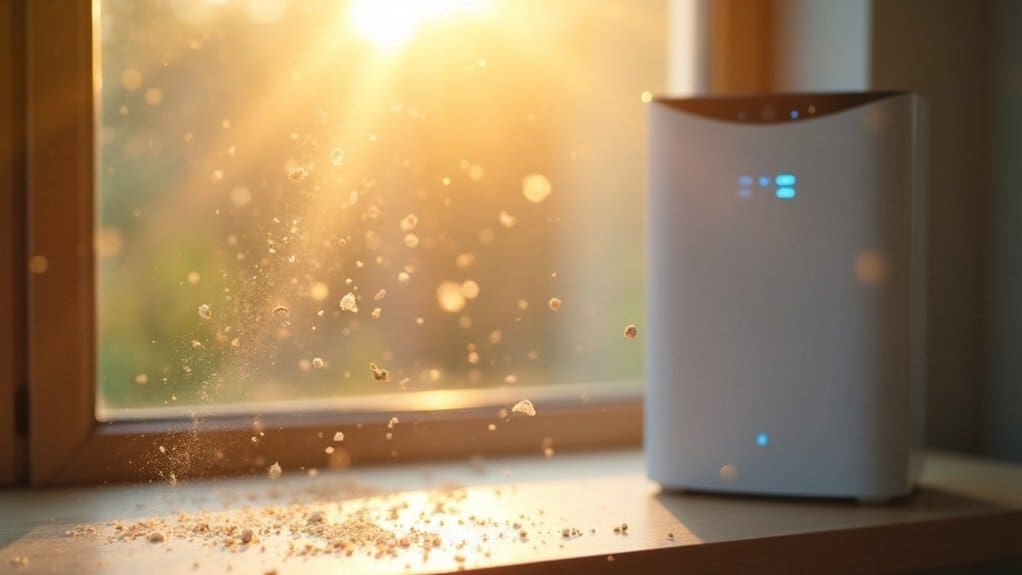
Professional air filtration installation transforms your HVAC system into a powerful allergen removal mechanism by capturing 99.97% of particles 0.3 microns or larger through HEPA technology. You’ll experience significant relief from pet dander, pollen, and mold spores as these systems continuously filter recirculating air throughout your home. Expert installation guarantees proper sizing, ideal airflow integration, and maximum filtration efficiency that reduces indoor allergen concentrations by 2-5 times compared to standard filters, while thorough strategies below optimize your indoor air quality further.
Key Takeaways
- Professional air filtration installation captures 99.97% of airborne allergens including pollen, pet dander, and mold spores.
- HEPA filters integrated into HVAC systems provide whole-home allergen reduction compared to portable units alone.
- Proper installation ensures optimal airflow and filtration efficiency while maintaining equipment warranties and performance standards.
- Combined HEPA and activated carbon filtration removes both particles and odors for comprehensive indoor air improvement.
- Regular filter maintenance and replacement sustains long-term allergen control and prevents system performance degradation.
Understanding Indoor Air Quality and Common Allergen Sources
Why does your indoor air quality often pose greater health risks than the air outside your home? Indoor air pollution concentrates allergens at levels 2-5 times higher than outdoor environments, creating significant health hazards that the EPA ranks among the top five environmental risks.
Your home harbors multiple allergen sources: pollen infiltrates through windows and doors, pet dander accumulates in carpets and upholstery, and mold spores develop in humid areas. These airborne particles circulate continuously through your HVAC system without proper filtration controls.
Effective particle capture requires systematic approaches. Your HVAC air filters serve as the primary defense mechanism, trapping microscopic allergens before circulation. However, standard filters often lack sufficient density for ideal performance. Supplemental air purifiers target specific zones where allergen sources concentrate.
Proper ventilation management balances fresh air intake with controlled filtration. You’ll achieve maximum allergen reduction by coordinating HVAC filtration with strategic air purifier placement, creating comprehensive indoor air quality control systems.
Types of Air Filtration Systems for Allergy Relief
How effectively can different filtration technologies capture allergens ranging from large pollen grains to microscopic mold spores? Your selection depends on particle size and contamination type.
HEPA filters excel at removing 99.97% of airborne particles 0.3 microns or larger, making them ideal for capturing dust mites, pet dander, and mold spores. You’ll find these integrated into whole-house HVAC system installations or standalone portable room air cleaners.
Activated carbon filters complement HEPA technology by adsorbing odors and chemical vapors that mechanical filtration can’t capture. You can install these in combination units for thorough allergen control.
For targeted treatment, portable room air cleaners offer flexibility in high-allergen areas like bedrooms. Whole-house filtration system integration provides consistent allergen reduction throughout your home.
Consider particle size when selecting equipment: dust mites and pet dander require different filtration approaches than microscopic mold spores. Match your filtration system specifications to your specific allergen profile for effective performance.
Benefits of Professional Air Filtration Installation
Professional installation consistently delivers superior air filtration performance compared to DIY approaches by guaranteeing your system operates at manufacturer-specified efficiency levels. You’ll receive proper system sizing calculations that match your HVAC system’s airflow requirements, preventing bypass issues that reduce filtration effectiveness against allergens and pollutants.
Expert technicians integrate advanced air purification technologies including HEPA filters, activated carbon media, and UV sterilization units into your existing ductwork. They’ll position air filters strategically throughout your home to maximize whole-home air quality improvements while maintaining ideal system pressure differentials.
Professional installation ensures compliance with equipment specifications and warranty requirements. Your installer will calibrate fan speeds, verify seal integrity, and establish baseline performance metrics for ongoing monitoring.
You’ll receive thorough guidance on filter selection based on your specific allergy triggers, replacement schedules aligned with usage patterns, and system adjustments for seasonal variations. This expert oversight guarantees sustained indoor air quality improvements and prevents costly equipment damage from improper filter replacement procedures.
Maintenance Requirements for Optimal Filter Performance
Ideal filter performance depends entirely on adhering to manufacturer-specified maintenance schedules that account for your system’s operational parameters and environmental load factors. You’ll need to replace standard filters every 1-3 months, depending on your home’s size, occupancy levels, and existing air quality conditions. Mark installation dates directly on new filters to track replacement intervals precisely.
HVAC professionals can determine suitable maintenance frequencies based on your specific system requirements and particle load exposure. Neglecting timely replacement causes contaminant buildup, dramatically reducing filtration effectiveness and potentially degrading indoor air quality below pre-installation levels.
For permanent filters, you must perform regular cleaning procedures to remove accumulated particles and debris. Use manufacturer-approved cleaning solutions and drying protocols to maintain peak performance standards. Monitor pressure differentials across filter media to identify when cleaning or replacement becomes necessary. Proper maintenance guarantees consistent contaminant removal and preserves your system’s long-term filtration capabilities.
Additional Strategies to Enhance Indoor Air Quality
Beyond mechanical filtration systems, you’ll achieve superior allergen control by implementing complementary air quality enhancement protocols that target specific contamination sources throughout your living environment.
Deploy HEPA-filter vacuum units weekly to extract accumulated dust, pet dander, and particulate allergens from carpeting and upholstery before they recirculate through your HVAC system. Eliminate scented candles, synthetic air fresheners, and VOC-containing cleaning products that compromise indoor air pollution levels and trigger respiratory sensitivities.
Establish controlled ventilation schedules by opening windows when outdoor conditions permit, allowing fresh air exchange to dilute concentrated indoor pollutants your air filtration system processes. Install whole-home dehumidifiers integrated with your HVAC system to maintain 30-50% relative humidity, preventing mold proliferation and dust mite reproduction.
Position air-purifying plants strategically throughout rooms to supplement mechanical air purifiers through natural carbon dioxide absorption and oxygen production. These targeted humidity control and ventilation strategies create synergistic effects with your primary filtration equipment, maximizing allergen reduction efficiency.
Conclusion
You’ll transform your indoor environment from an allergen battlefield into an impossibly pristine sanctuary through strategic air filtration installation. Your HEPA filtration system won’t just capture particles—it’ll obliterate microscopic invaders with surgical precision. By maintaining filter replacement schedules religiously and calibrating your equipment parameters flawlessly, you’ll achieve air quality that’s practically laboratory-grade. Don’t underestimate the exponential impact: proper installation and maintenance protocols will revolutionize your respiratory health beyond conventional expectations.