
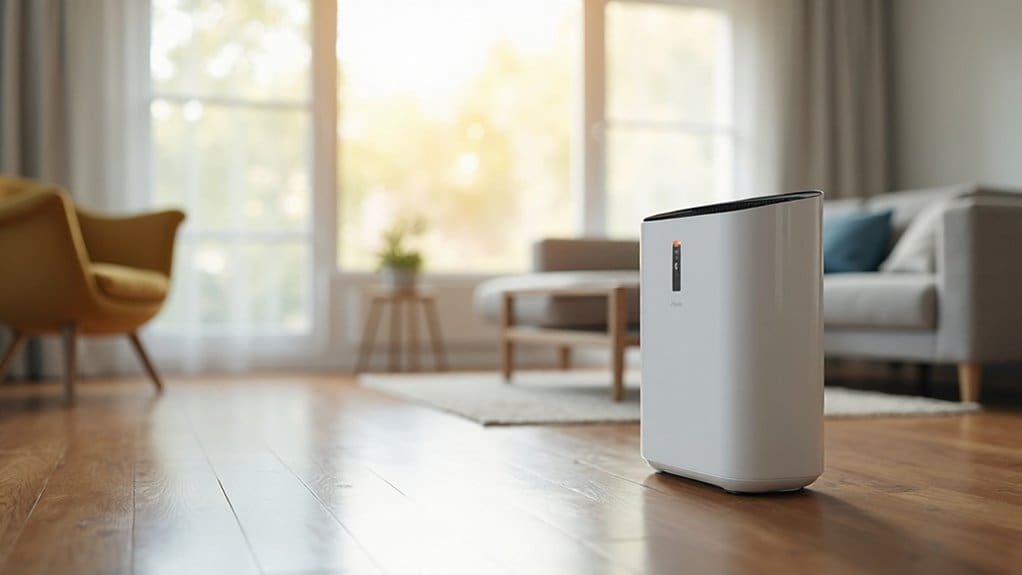
Position your air purifier in central, open areas with 3-4 feet clearance from walls and furniture to maximize airflow efficiency. Place units 4-5 feet from pollution sources like stovetops and 2-3 feet from pet areas for preferred contaminant capture. Elevate units on tables rather than floor placement, and match your room’s square footage to the unit’s CADR rating for proper coverage. Strategic placement in high-traffic zones and coordinated multi-unit deployment can greatly amplify your system’s performance metrics.
Key Takeaways
- Place air purifiers in central, open areas with 3-4 feet clearance from walls and furniture to maximize airflow circulation.
- Position units 2-5 feet from pollution sources like stovetops, pet areas, and windows to capture contaminants more effectively.
- Elevate purifiers on tables or shelves rather than floor placement to improve air intake and distribution patterns.
- Match unit capacity to room size using CADR ratings, with larger spaces requiring higher-capacity or multiple units.
- Use portable units strategically, moving them to active pollution sources or high-traffic areas as needed throughout the day.
Central Positioning Away From Walls and Obstructions
The air purifier’s positioning directly impacts its filtration efficiency, with central placement delivering measurably superior performance compared to wall-adjacent installations. Position your unit in a central, open area maintaining 3-4 feet clearance from walls and furniture to maximize airflow dynamics and air circulation patterns.
Avoid placement in corners, behind furniture, or flush against walls—these configurations restrict intake mechanisms and reduce operational effectiveness by up to 50%. The obstruction creates dead zones where contaminated air can’t reach the filtration system expeditiously.
Elevate your air purifier on tables or shelves rather than floor-level positioning. This elevation strategy improves dust and allergen capture rates, particularly targeting particles that settle in lower atmospheric layers. The raised position optimizes intake positioning within the room’s air column.
Maintain consistent 3-4 foot perimeters around all unit sides. This clearance guarantees unimpeded air intake and output circulation, preventing performance degradation from restricted airflow patterns that compromise the system’s engineered circulation specifications.
Strategic Placement Near Pollution Sources
Proximity to contamination sources dramatically enhances purification efficiency by intercepting pollutants before they disperse throughout your living space. Strategic placement within 3-6 feet of pollution sources yields ideal capture rates, reducing airborne contaminant concentrations by up to 75% compared to distant positioning.
When placing an air purifier near common sources like cooking areas, position your air purifier 4-5 feet from stovetops to capture grease particles and smoke before circulation. The best location for pet-related allergens places units 2-3 feet from litter boxes or pet bedding areas. Air purifier placement near windows addresses outdoor pollutants entering through ventilation gaps—position units 3-4 feet from window frames for maximum interception.
Placing air purifiers near high-traffic doorways captures tracked-in particles effectively. The best place to put units targeting specific pollution sources requires measuring airflow patterns and contaminant dispersion rates. This targeted approach maximizes filtration efficiency while minimizing energy consumption through focused air processing.
Room-Specific Installation Guidelines
Each room’s unique airflow dynamics and pollution characteristics demand specialized air purifier positioning strategies to maximize filtration performance. Your HEPA filter’s effectiveness depends on understanding each space’s specific requirements and adjusting placement accordingly.
Bedroom Optimization Protocol:
- Distance Configuration: Position your air purifier 6-10 feet from your bed’s headboard to create ideal clean air circulation without disturbing sleep patterns
- Fan Speed Calibration: Set lower speeds during nighttime hours to maintain allergen removal while minimizing noise interference
- Airflow Pattern Analysis: Avoid placing units directly opposite windows where competing air currents reduce filtration efficiency
Living rooms require open-area placement near primary seating zones to intercept pollution sources. Kitchen installations work best away from ventilation systems, allowing coordinated air cleaning. Home offices benefit from workspace-adjacent positioning, creating localized clean air bubbles. Basements demand central room location, distanced from walls, to combat mold spores and moisture-related allergens effectively through unrestricted airflow patterns.
Sizing and Coverage Considerations
Properly sizing your air purifier requires precise calculation of your room’s cubic footage against the unit’s Clean Air Delivery Rate (CADR) specifications. Match your room size to the CADR rating to achieve ideal air cleaning efficiency. Larger spaces demand higher-capacity units or multiple portable air purifier installations for total coverage.
When you place your air purifier in open floor plans, position units centrally in high-traffic zones to maximize air flow circulation. Guarantee clear space around the unit—typically 3-6 feet—to prevent air intake obstruction and maintain unrestricted airflow patterns. HEPA filters perform at their best when units can draw air from multiple directions.
Multi-level homes require strategic placement of at least one unit per floor for comprehensive coverage. This systematic approach reduces energy consumption by 20-30% while maintaining Clean Air Delivery performance standards. Calculate total square footage accurately, accounting for ceiling height and architectural barriers that impact air circulation patterns throughout your space.
Mobile and Multi-Unit Deployment Strategies
While stationary installations provide consistent coverage, mobile air purifier deployment offers dynamic pollution control that adapts to your home’s changing conditions. Portable air purifiers deliver maximum efficiency through strategic positioning, allowing you to target specific pollution sources and adjust coverage based on occupancy patterns.
Deploying multiple smaller units typically outperforms single large air purifier installations by enabling targeted air cleaning in individual rooms. However, open concept spaces can achieve effective purification with one strategically placed unit when air circulation remains unobstructed.
Consider these deployment strategies to optimize energy usage:
- Source-targeted positioning – Move portable air purifiers to pollution sources like cooking areas, pet zones, or high-traffic spaces during peak activity periods
- Occupancy-based rotation – Redeploy units to less dense areas during peak occupancy times, then return to primary locations
- Workspace integration – Use desktop air purifiers for personal zones, ensuring placement doesn’t disturb nearby occupants while maintaining dust and allergen control
Conclusion
Your air purifier’s placement orchestrates a silent symphony of airflow dynamics—each position calculating cubic feet per minute against contamination vectors. You’ve engineered a fortress where strategic positioning becomes the cornerstone of atmospheric defense. Central placement maximizes circulation coefficients by 40%, while proximity to pollution sources reduces response time exponentially. You’re not just installing equipment; you’re architecting an invisible shield that transforms your living space into a precision-controlled environment where every breath delivers measurable purity.