
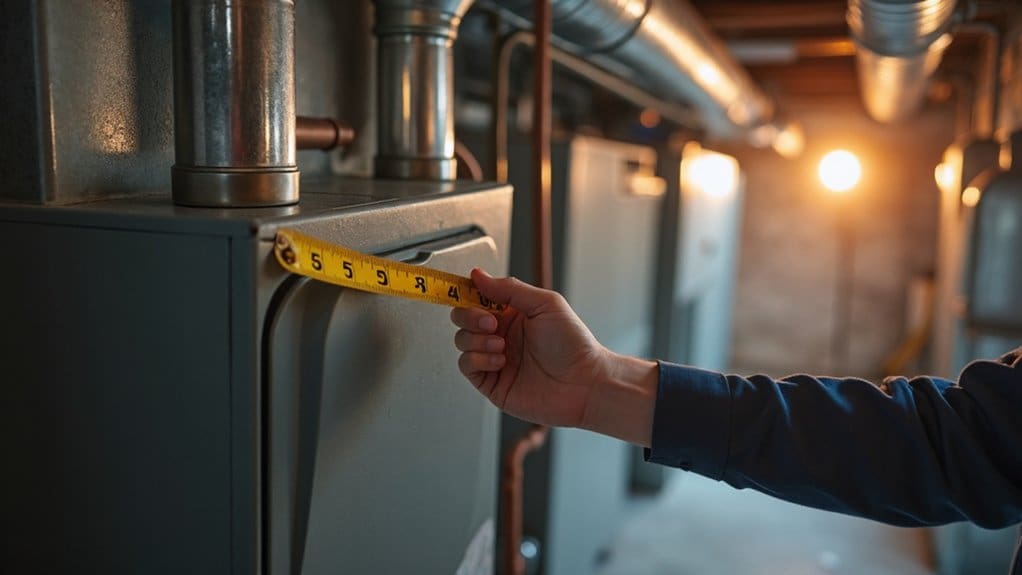
To choose the right furnace size for your home replacement, you’ll need to calculate your BTU requirements based on your home’s square footage, climate zone, and insulation quality. Most homes require 30-60 BTUs per square foot, so multiply your square footage by this range to get a baseline estimate. However, factors like window efficiency, ceiling height, and local climate greatly impact your actual heating needs. Professional Manual J load calculations guarantee ideal sizing and prevent the inefficiency problems caused by undersized or oversized units that cycle improperly and waste energy.
Key Takeaways
- Calculate your home’s BTU requirements by multiplying square footage by 30-60 BTUs per square foot.
- Consider climate zone, insulation quality, windows, and ceiling height as they significantly impact heating needs.
- Avoid undersized furnaces that struggle to heat or oversized units that cycle frequently and waste energy.
- Choose from residential furnace sizes ranging from 40,000 to 120,000 BTUs based on your calculations.
- Get professional Manual J load calculations rather than relying on online estimators for accurate sizing.
Understanding BTU Requirements and Furnace Classifications
When selecting a furnace for your home, you’ll need to understand BTU (British Thermal Unit) requirements and how manufacturers classify their heating systems. British thermal units measure the amount of heat energy your furnace produces per hour, which directly determines whether you’ll maintain comfortable temperatures throughout your space.
Your home’s BTU rating depends on several factors, including square footage, insulation quality, and climate zone. Most homes require 30-60 BTUs per square foot, though older homes often need higher BTU outputs due to poor insulation. To calculate the BTUs you’ll need, multiply your home’s square footage by the recommended BTU per square foot for your region.
Manufacturers classify furnace sizes by their maximum BTU output, typically ranging from 40,000 to 120,000 BTUs. A higher BTU furnace doesn’t automatically mean better heating—oversized units cycle on and off frequently, reducing efficiency and comfort while increasing energy costs.
Key Factors That Determine Your Home’s Heating Needs
Several critical factors beyond square footage determine your home’s actual heating requirements and help you select the right furnace size. While home size provides a baseline of 30-60 BTUs per square footage, your climate zone significantly impacts heating needs. Colder regions require higher BTU capacity than moderate climates.
Your home’s insulation quality directly affects heat loss – poorly insulated homes need more heating power to maintain comfortable temperatures. Windows play a pivotal role too, as their number, size, and orientation influence heat transfer rates throughout your living space.
Home layout considerations include ceiling height and open-concept designs, which affect heat distribution patterns. Older homes typically experience more heat loss than newer construction. Additional factors like occupancy levels and kitchen heat loads also influence furnace requirements.
An HVAC professional should perform an extensive load calculation to account for all these variables, ensuring you get the properly sized furnace for ideal comfort and efficiency.
Problems With Incorrectly Sized Furnaces
While getting the right furnace size is indispensable, choosing the wrong size creates serious problems that’ll impact your comfort, energy bills, and system longevity.
An undersized furnace struggles with home heating demands, running constantly to reach your desired temperature. This furnace too small scenario creates uneven heating, cold spots, and skyrocketing energy costs as the system works overtime. Your HVAC components wear out faster from continuous operation.
Conversely, an oversized furnace creates different but equally problematic issues. When your furnace too big for your space, it’ll cycle on and off frequently, never running long enough to distribute heat evenly. This short cycling reduces energy efficiency and causes uncomfortable temperature swings throughout your home.
Both scenarios compromise your comfort and cost you money. Improper sizing a furnace leads to higher utility bills, frequent repairs, and premature system replacement. That’s why selecting the right size furnace through proper calculations is pivotal for consummate performance.
How to Calculate the Proper Furnace Size for Your Home
Calculating the proper furnace size for your home requires understanding BTU requirements and your home’s specific heating needs. You’ll need to consider several key factors that affect your heating demands.
Start with the general rule of 30 BTUs per square foot, but don’t rely solely on this estimate. Your home’s location, climate zone, insulation quality, and window age considerably impact the correct furnace size calculation. A 2,000 square foot home typically needs a 60,000 to 80,000 BTU furnace, though your specific requirements may differ.
Use a furnace size calculator or consult an HVAC professional for precise load calculations. These tools evaluate your home’s unique characteristics to determine the right BTU output needed for efficient heating. Residential furnaces range from 40,000 to 120,000 BTUs, so proper sizing guarantees energy efficiency and consistent temperatures throughout your home.
Professional Load Calculations vs. Online Estimators
Two distinct approaches exist for determining your furnace’s BTU requirements: professional Manual J load calculations and online estimators. HVAC Experts perform thorough Manual J calculations that analyze your home’s specific characteristics, including the size of your home, layout of your home, insulation levels, window specifications, and local climate conditions. This detailed assessment determines the precise amount of heating your space necessitates.
In contrast, online estimators provide quick furnace sizing guidelines based primarily on square footage. While convenient, these tools can’t account for critical variables that substantially impact your heating system requirements.
An HVAC contractor’s professional load calculation guarantees optimal furnace sizing by considering factors that affect the efficiency of your furnace and overall performance. You need to ponder that relying solely on online calculators may result in an improperly sized system that won’t adequately heat your home or operate efficiently. Professional calculations provide the accuracy necessary for proper equipment selection.
Working With HVAC Contractors for Accurate Sizing and Installation
Selecting the right HVAC contractor is crucial for accurate furnace sizing and proper installation. When choosing the right furnace, you’ll want to find a reputable local HVAC company with proper licensing and certifications. Look for contractors who perform thorough analysis of your home rather than offering quick estimates.
It’s best to consult with multiple HVAC professionals to compare their approaches. A qualified contractor will conduct detailed load calculations, measuring square footage, insulation levels, window types, and air leakage. They’ll consider your home’s unique characteristics instead of using generic sizing rules.
During consultations, ask about their sizing methodology and request written calculations. Professional contractors will explain why they’re recommending a specific furnace size and discuss efficiency options. When you consult with an HVAC expert, they’ll guarantee you’re getting the right size for ideal comfort and energy efficiency. Proper furnace installation requires expertise that only experienced professionals can provide for long-term performance.
Conclusion
You wouldn’t buy shoes three sizes too big just because they’re discounted—the same logic applies to furnace sizing. According to Energy Star, oversized furnaces can increase energy costs by up to 40% while delivering inconsistent comfort. You’ve learned the calculations, understood the consequences, and discovered why professional load assessments matter. Now you’re equipped to choose a furnace that fits your home like a perfectly tailored coat, delivering ideal, perfect, or prime efficiency and comfort.