
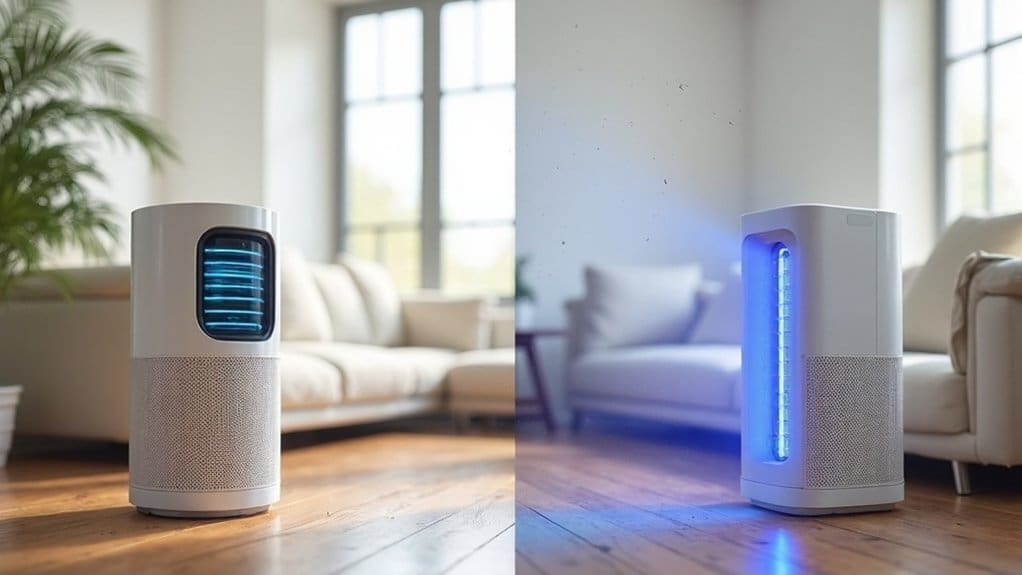
HEPA air purifiers are typically the better choice for most homes since they remove 99.97% of particles as small as 0.3 microns throughout your entire living space. UV systems only sterilize microorganisms that pass directly through their light zone and can’t capture dust or pollen. HEPA filters offer flexible installation options, lower long-term costs, and simpler maintenance with just periodic filter changes. The following comparison will help you make the most informed decision for your specific needs.
Key Takeaways
- HEPA filters capture 99.97% of particles including dust and pollen, while UV only sterilizes microorganisms.
- HEPA systems offer whole-home protection through HVAC integration, whereas UV typically covers single rooms only.
- Standalone HEPA units provide plug-and-play installation, while UV systems require professional HVAC ductwork installation.
- HEPA filters need periodic replacement, but UV systems require frequent bulb changes and cleaning maintenance.
- HEPA systems cost more upfront but have lower long-term operating expenses than UV purifiers.
Understanding HEPA Air Purification Technology
When you’re comparing air purification technologies, HEPA (High-Efficiency Particulate Air) filters stand out as the gold standard for mechanical air cleaning. These advanced filters physically capture 99.97% of airborne particles as small as 0.3 microns, making them incredibly effective at removing dust, pollen, mold spores, and pet dander from your home’s air.
Unlike chemical-based purification methods, HEPA filtration works through purely mechanical means, trapping particles within dense filter media without producing harmful byproducts like ozone. This makes HEPA air purifiers particularly safe for households with respiratory sensitivities or concerns about air quality.
The thorough nature of HEPA systems allows them to provide whole-home air cleaning by continuously circulating and filtering air throughout your house. While you’ll need to replace filters regularly for excellent performance, the maintenance remains straightforward. The superior particle removal efficiency of HEPA technology makes it an outstanding choice for improving indoor air quality through reliable, proven filtration methods.
How UV Air Purifiers Work to Eliminate Contaminants
While HEPA filters rely on physical trapping mechanisms, UV air purifiers take a completely different approach by using ultraviolet light to destroy contaminants at the molecular level. When you install a UV air purification system, it emits UV-C light that penetrates harmful microorganisms and disrupts their DNA structure, rendering them unable to reproduce or cause illness.
UV light effectively neutralizes bacteria, airborne viruses, and other pathogens that pass through your system’s chamber. Unlike traditional filters that trap airborne particles, UV purifiers actually kill mold and bacteria on contact. You’ll find these systems work continuously to clean the air by sterilizing microorganisms rather than collecting them.
However, UV air purification works best against biological contaminants. It won’t eliminate dust, pollen, or chemical pollutants like HEPA filters do. Many homeowners combine both technologies for extensive air purification coverage throughout their homes.
Comparing Filtration Effectiveness and Coverage Areas
The effectiveness of HEPA and UV air purifiers varies markedly in both their filtration capabilities and coverage areas. HEPA filters excel at physically capturing particles, removing 99.97% of contaminants as small as 0.3 microns from your air. This thorough filtration system traps dust, pollen, pet dander, and microscopic pollutants with exceptional efficiency.
UV Air purifiers work differently, sterilizing only particles that pass directly through their light exposure zone. This limitation greatly reduces their overall effectiveness compared to HEPA air filters.
Coverage areas present another stark contrast. When integrated into your HVAC system, air filtration using HEPA technology provides whole-home protection, cleaning air throughout every room. UV air purifier systems typically cover single rooms or specific areas, limiting their protective scope.
For extensive air quality improvement, HEPA-based air filtration delivers superior particle removal across your entire home, while UV systems offer more localized treatment with restricted effectiveness against airborne contaminants.
Installation Requirements and System Integration Options
Beyond performance considerations, installation requirements and system integration options present distinct differences between HEPA and UV air purifiers that’ll affect your decision-making process. HEPA air cleaners offer flexible installation choices – you can select standalone units requiring only power sources for single-room coverage, or integrate them into your air conditioning system’s ductwork for whole-home indoor air quality improvement.
UV air purifiers range differently in installation approach, designed specifically for HVAC integration near air handlers or coils. Unlike portable HEPA units you can move between rooms, UV systems treat circulating air throughout your entire home but require professional installation within your ductwork.
Standalone HEPA units provide immediate plug-and-play functionality, while HVAC-integrated systems – both HEPA and UV – demand professional installation and higher costs. Your choice between room-specific air filter solutions versus whole-home bacteria and mold spores treatment depends on coverage needs and installation complexity preferences.
Operating Costs and Long-Term Maintenance Considerations
Once you’ve determined installation feasibility, operating costs and maintenance requirements become essential factors that’ll profoundly impact your long-term investment. While high-efficiency particulate air systems require higher upfront costs, they’re substantially more economical for ongoing operational expenses compared to UV light systems.
Your HEPA air filtration systems offer straightforward maintenance with periodic filter replacement, enhancing indoor air quality without complex upkeep. Conversely, UV light systems demand regular bulb replacement and frequent cleaning to maintain ideal performance, creating higher maintenance costs over time.
These ongoing operational differences make HEPA systems a more cost-effective solution for most homeowners. You’ll appreciate the convenience of reduced maintenance requirements, which translates to lower long-term ownership costs. When evaluating your options, factor in both initial purchase price and lifetime maintenance costs. The cost savings associated with HEPA air filtration systems ultimately provide better value, making them the financially smarter choice for sustained indoor air quality improvement.
Safety Concerns and Ozone Emission Differences
Among the most critical differences between these air purification technologies, safety concerns present a compelling argument for choosing HEPA systems over UV alternatives. HEPA air purifiers operate without producing any ozone, while certain UV air purifiers can emit this potentially harmful gas as a byproduct during operation.
This ozone emission difference dramatically impacts your indoor air quality and health. If you’re dealing with respiratory issues like asthma or COPD, ozone exposure can trigger serious complications including coughing, throat irritation, and breathing difficulties. The safety advantage of HEPA systems becomes even more pronounced in homes with vulnerable family members.
You’ll find that ozone-free operation makes HEPA technology the safer choice for continuous indoor use. While UV air purifiers offer effective purification capabilities, their potential to compromise the very air quality they’re meant to improve creates unnecessary health risks that HEPA systems simply don’t pose.
Choosing the Best Air Purification Solution for Your Needs
With safety considerations addressed, selecting the right air purification technology depends on your specific indoor air quality challenges and household circumstances. If you’re dealing with allergies, dust, or pet dander, HEPA air purifiers offer superior whole-home filtration by removing 99.97% of particles as small as 0.3 microns. These systems integrate seamlessly with your HVAC and provide all-encompassing indoor air quality improvement.
Choose UV air purifiers if your primary concern involves bacteria, viruses, or mold growth. Installing UV systems over HVAC coils effectively prevents microbial contamination, though they won’t address particle pollution.
Consider your budget carefully. HEPA filters require higher upfront investment but offer lower long-term costs, while UV systems need regular bulb replacements. For maintenance simplicity, HEPA filters are straightforward to replace, whereas UV bulbs require periodic cleaning.
Homes with severe allergy sufferers typically benefit more from HEPA technology’s broader pollutant removal capabilities compared to UV’s targeted antimicrobial effects.
Frequently Asked Questions
Which Is Better, HEPA or UV Air Purifier?
You’ll find HEPA purifiers offer more effective particle removal with affordable operating costs and versatile installation options. They’re quieter, don’t produce ozone, and provide customizable filter types for better air circulation efficiency.
Why Are HEPA Filters Rarely Used in Homes?
You’ll find HEPA filters aren’t common in homes due to high initial cost, frequent cleaning requirements, susceptibility to clogging, limited airflow capacity, and potential energy consumption issues that make them impractical for most residential applications.
How to Choose the Right Air Purifier for Your Home?
Choosing an air purifier isn’t rocket science—you’ll need to match room size requirements with coverage area specifications, consider filter replacement frequency costs, compare noise levels, check energy efficiency ratings, and evaluate particle capture efficiency for your specific needs.
What Are the Disadvantages of HEPA Air Purifiers?
HEPA air purifiers have higher initial costs and require regular filter replacements. You’ll notice increased energy consumption, potential noise levels, and airflow restrictions. Their bulky design limits placement options, and they’re less effective against gases and odors.
Conclusion
You’ve weighed the filtration power, you’ve considered the costs, and you’ve evaluated your home’s unique needs. Whether you choose HEPA’s proven particle capture or UV’s germicidal effectiveness, you’re investing in cleaner air and better health. Don’t rush this decision—you’ll live with it daily. Compare your budget constraints, assess your space requirements, and match the technology to your family’s specific air quality concerns for ideal results.