
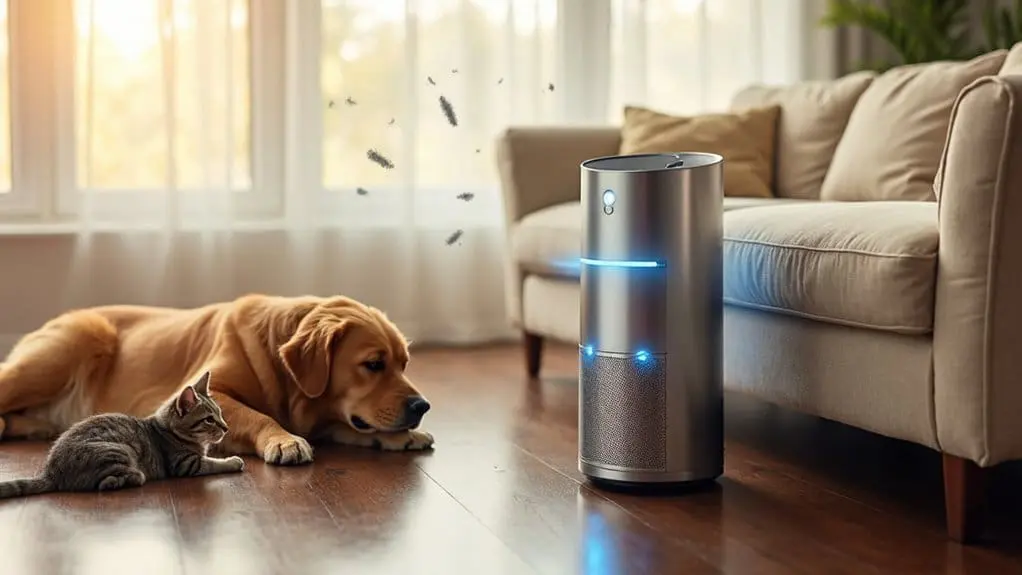
You’ll need dual-stage air purifiers with HEPA and activated carbon filters to capture 99.97% of pet dander while neutralizing odors from litter boxes and wet fur. Position units in high-traffic pet areas at least two feet from walls, selecting models with CADR ratings at 67% of your room’s square footage. Replace HEPA filters every 6-12 months and carbon filters every 3-6 months for ideal performance. Strategic placement and proper maintenance procedures guarantee thorough air quality management for pet households.
Key Takeaways
- Choose dual-filtration systems with HEPA filters for dander and activated carbon filters for odor elimination.
- Install purifiers in high-traffic pet areas like living rooms, bedrooms, and near litter boxes.
- Position units at least 2 feet from walls with unobstructed airflow for optimal performance.
- Select purifiers with CADR ratings at least 67% of your room’s square footage.
- Replace HEPA filters every 6-12 months and activated carbon filters every 3-6 months.
Choosing the Right Air Purifier for Pet Hair and Dander Control
How effectively will your air purifier combat pet-related contaminants? The answer depends on selecting equipment with specialized filtration capabilities. HEPA filters represent the gold standard for trapping pet dander and pet fur particles, capturing 99.97% of allergens down to 0.3 microns. This filtration efficiency greatly reduces allergic reactions among household occupants.
Complement HEPA technology with activated charcoal filters to neutralize persistent odors from litter boxes and wet fur. These dual-filtration systems form the foundation of effective air purifiers for pets.
Evaluate the clean air delivery rate to ensure sufficient room coverage and rapid contaminant removal. Higher CADR ratings indicate faster purification cycles, vital for maintaining clean air in pet environments.
Prioritize quiet operation to prevent disturbing your animals during continuous operation. Energy-efficient design becomes important since pet owners typically run purifiers 24/7 for ideal air quality maintenance, making low power consumption a cost-effective operational requirement.
Strategic Placement and Installation Tips for Maximum Effectiveness
While selecting the right air purifier establishes your foundation, proper placement determines whether you’ll achieve maximum pet dander and odor removal throughout your home.
Focus your strategic positioning on high-traffic pet areas where contamination concentrates most heavily. Install units in living rooms, bedrooms, and near litter boxes to capture airborne particles at their source. Position each purifier at least two feet from walls and furniture to maintain unobstructed airflow around the intake and exhaust vents.
Deploy multiple smaller units rather than relying on single large purifiers for extensive coverage throughout your living space. Elevation plays a critical role in effectiveness—place units on stands or tables to optimize clean air distribution within the breathing zone where you and your pets spend time.
Inspect placement regularly to guarantee pet beds, toys, and other obstructions don’t block airflow paths. These common household items can drastically reduce your purifier’s performance by restricting proper air circulation patterns.
HEPA and Activated Carbon Filter Requirements for Pet Owners
Beyond proper placement, your air purifier’s filtration system determines its actual effectiveness against pet-generated contaminants. HEPA filters capture 99.97% of pet dander and pet fur particles as small as 0.3 microns, while activated carbon filters neutralize pet odors from litter box odors, wet fur, and waste materials.
For thorough particle and odor removal, you’ll need dual-stage filtration combining both technologies. This configuration addresses the complete spectrum of pet-related indoor air quality issues.
Critical maintenance requirements include:
- Replace HEPA filters every 6-12 months – degraded filters allow pet dander to recirculate, triggering allergic reactions
- Change activated carbon filters every 3-6 months – saturated carbon loses odor-absorbing capacity, leaving litter box odors uncontrolled
- Monitor filter indicators monthly – delayed filter replacement compromises your family’s respiratory health and comfort
Multi-pet households require more frequent filter replacement due to accelerated contamination. High-performance filtration systems maintain ideal performance only through consistent maintenance schedules.
Room Size and CADR Considerations for Multi-Pet Households
The Clean Air Delivery Rate (CADR) determines your air purifier’s ability to process contaminated air in multi-pet environments. Calculate your CADR requirements by measuring the total square footage where pets roam freely. Apply the two-thirds rule: select an air purifier with CADR rating equal to at least 67% of your room size. For a 300 square foot space, you’ll need minimum 200 CFM CADR capacity.
Multi-pet households require higher CADR ratings due to increased pet dander and pet odors circulation. Open-concept layouts demand air purifiers with elevated CADR specifications to maintain consistent air quality across connected spaces. Position units strategically to maximize airflow coverage throughout the entire area.
Verify your selected air purifier combines adequate CADR performance with advanced filtration systems. HEPA filters capture microscopic pet dander particles, while activated carbon neutralizes persistent odors. This dual-filtration approach guarantees thorough air cleaning in spaces shared by multiple pets.
Maintenance and Filter Replacement Schedules for Optimal Performance
Proper maintenance schedules directly impact your air purifier’s effectiveness in controlling pet-related contaminants. Your HEPA filters require replacement every 6-12 months to maintain ideal air purification against pet dander accumulation. Clean pre-filters monthly to prevent airflow restrictions that compromise system performance. Activated charcoal filters need changing every 3-6 months for consistent pet odor elimination.
Base your filter replacement schedule on these critical factors:
- Heavy shedding seasons – Your beloved pets shed more during seasonal shifts, requiring accelerated filter maintenance to protect your family’s breathing space
- Multiple pet households – Each additional furry family member doubles the contamination load, demanding vigilant air quality monitoring
- Allergy severity levels – Your sensitive family members deserve consistently clean air through proactive filter replacement
Follow manufacturer’s recommendations as baseline parameters, then adjust based on actual usage patterns. Monitor airflow indicators and odor breakthrough to determine prime performance intervals. Consistent filter maintenance guarantees maximum air purification efficiency against pet-related contaminants.
Conclusion
You’ve engineered your air purification arsenal to combat pet-related contaminants like a precision instrument. Your HEPA filtration system now operates as the guardian against microscopic dander particles, while activated carbon filters neutralize odor molecules with surgical accuracy. By calculating your CADR requirements and positioning units strategically, you’ve created clean-air zones throughout your home. Maintain your filter replacement schedule religiously—your respiratory system and equipment longevity depend on this calculated approach to indoor air quality management.