
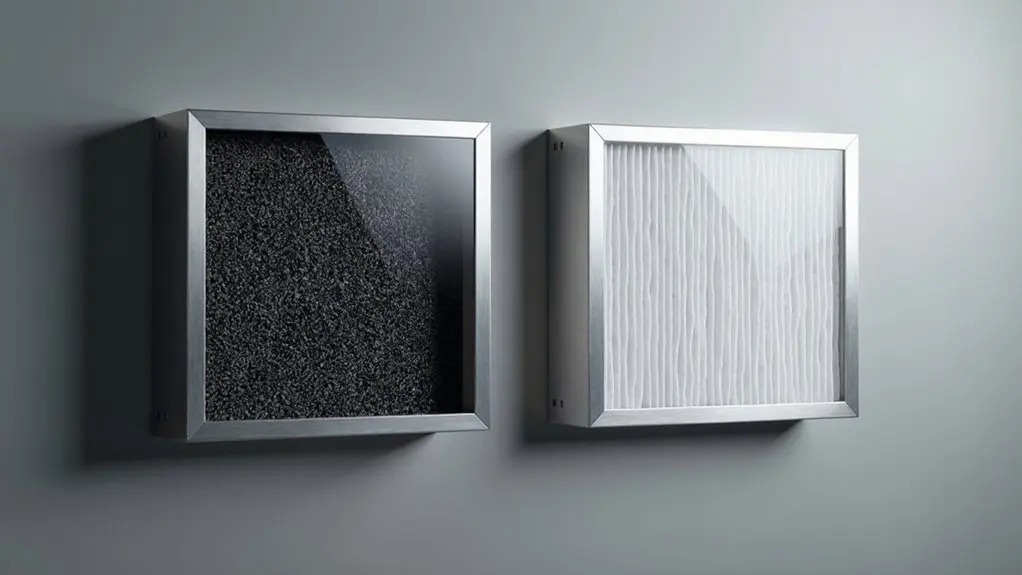
You’ll need HEPA filters if you’re targeting allergens, dust, and pet dander with 99.97% particle capture efficiency, while carbon filters excel at eliminating odors, VOCs, and chemical fumes through activated carbon adsorption. HEPA installation is straightforward with simple replacement schedules every 6-12 months, but carbon systems require more complex setup and frequent 3-6 month replacements. Consider dual systems for ideal air purification, though this increases maintenance complexity and costs. The specific requirements of your space will determine your best filtration strategy.
Key Takeaways
- HEPA filters offer straightforward installation with simple replacement, while carbon filters require more complex procedures and powerful fans.
- HEPA systems excel at capturing allergens and particles, making them ideal for allergy sufferers and dust control.
- Carbon filters effectively neutralize odors and chemical fumes, perfect for kitchens and areas with strong smells.
- HEPA filters need replacement every 6-12 months, while carbon filters require more frequent changes every 3-6 months.
- Combined HEPA and carbon systems provide comprehensive air purification but require managing dual filter replacement schedules.
Understanding HEPA Filter Technology and Installation Requirements
When you’re considering air filtration options for your home or office, HEPA filters stand out as the gold standard for removing microscopic contaminants from indoor air. These high-performance air filters capture at least 99.97% of airborne particles measuring 0.3 microns or larger, making them incredibly effective for air purification.
HEPA technology works through three key mechanisms: impaction, interception, and diffusion. Together, these processes trap fine particles that would otherwise circulate through your living space. You’ll find HEPA filters classified from grades 11 to 14, with higher numbers indicating superior filtration efficiency for your air purifier system.
Proper installation is critical for ideal performance. You must guarantee correct positioning and secure sealing to prevent air bypass, which compromises filtration effectiveness. Regular maintenance and timely filter replacement are essential to maintain high-quality air purification. Without proper upkeep, even the best HEPA filters won’t deliver the clean, healthy indoor environment you’re seeking.
Carbon Filter Systems: How They Work and Where to Install Them
While HEPA filters excel at capturing particles, carbon filter systems tackle a completely different category of air pollutants through their unique adsorption capabilities. Carbon filters effectively trap gaseous contaminants, VOCs, and chemical odors that slip right through particle-based filters.
The Role of Carbon Filters centers on activated carbon‘s massive surface area, which attracts and holds airborne molecules. These activated carbon filters work by pulling contaminants into tiny pores where they’re permanently trapped. Unlike HEPA systems that block particles, carbon filters target molecular-level pollutants.
Install carbon filter systems in kitchens where cooking odors linger, industrial spaces with chemical emissions, or areas with pet smells. You’ll need both filters in many situations since particles vs. gases require different approaches. While HEPA filters remove dust and allergens, carbon filters remove odors and chemicals. Place them in HVAC systems or standalone purifiers, ensuring proper airflow to maximize their adsorption potential.
Comparing Installation Complexity Between HEPA and Carbon Systems
Most homeowners find HEPA filter installation considerably more straightforward than setting up carbon filtration systems. You’ll discover that HEPA filters typically slide into place with minimal effort, requiring simple replacement when needed. Carbon Filters in Air purification systems often demand more complex procedures, as you’ll need to replenish carbon media or replace entire cartridges periodically.
When installing either system, you’ll notice different airflow requirements. Carbon filters usually need more powerful fans to overcome increased resistance, while HEPA filters don’t remove this challenge entirely but handle it better. Proper placement becomes pivotal for trapping particles effectively with HEPA systems, whereas carbon filters are less position-sensitive.
Filter positioning matters greatly for particulate capture. HEPA systems require precise sealing to ascertain filters are highly efficient at capturing contaminants. Regular maintenance proves more straightforward with HEPA installations, as you’ll face fewer disassembly requirements compared to carbon-based systems.
Target Pollutants: Matching Filter Type to Your Specific Air Quality Needs
Understanding your home’s specific air quality challenges determines which filter technology will deliver the best results for your situation. HEPA filters excel when you’re battling allergens, dust, or pet dander since these filters trap particles as small as 0.3 microns with 99.97% efficiency. They’re your go-to choice if family members suffer from allergies or asthma, as they capture particles that trigger respiratory issues.
Carbon filters take a different approach, targeting what HEPA can’t handle. When cooking odors, chemical fumes, or VOCs compromise your air quality, carbon’s adsorption properties neutralize these gaseous pollutants. This type of filter works best in kitchens, near smoking areas, or homes with strong chemical odors.
For thorough air cleaning, you’ll want both technologies working together. Combined systems ascertain filters remove both particulate matter and odors, addressing multiple pollution sources simultaneously for ideal indoor air quality.
Cost Analysis of Installing Single vs. Dual Filter Systems
Your filtration budget involves more than the sticker price on the unit itself. Single air filter systems typically cost less upfront but require frequent replacements, driving up long-term expenses. HEPA filters capture particles effectively, while carbon filters remove odors and volatile organic compounds (VOCs).
An extensive cost analysis reveals dual filter systems combining High Efficiency Particulate Air and carbon technologies often justify their higher initial investment. Quality dual systems provide superior air purification coverage and potentially extended filter lifespans, reducing replacement frequency.
Consider your specific air quality challenges when evaluating costs. If you’re primarily improving air quality by targeting allergens, a single HEPA system might suffice. However, homes with cooking odors, pet smells, or VOC concerns benefit from dual filtration despite higher upfront costs.
Factor in energy consumption and airflow rates when calculating total operating expenses. Evaluate your indoor environment needs, available space, and long-term budget to determine the most economical filtration solution.
Maintenance and Replacement Considerations for Each Filter Type
While initial costs matter when choosing filtration systems, ongoing maintenance determines your system’s long-term effectiveness and expense. HEPA and carbon filters require different replacement schedules that’ll impact your budget and air quality results.
Your HEPA filter needs replacement every 6-12 months to effectively remove fine particles like dust and particles like mold. These filters maintain their ability to capture 99.97% of contaminants when properly cared for. Carbon filters, however, require more frequent attention—you’ll replace them every 3-6 months depending on odor exposure and usage patterns.
It’s important to understand that neglecting filter changes dramatically reduces your purifier’s performance. Air Purifiers with dual filtration systems mean you’re managing two replacement schedules, but they enhance indoor air quality more thoroughly than single-filter units.
Beyond filter changes, clean your purifier housing regularly and monitor filter life indicators. This widely used maintenance approach guarantees your system continues delivering ideal air cleaning capabilities throughout its lifespan.
Selecting the Right System Based on Room Size and Air Quality Goals
Two critical factors determine which filtration system will deliver the best results for your home: your room’s square footage and the specific air quality challenges you’re facing.
For smaller spaces dealing with smoke, cooking odors, or chemical fumes, a carbon filter will help eliminate these gaseous pollutants effectively. When you select an air purifier with activated carbon, it’ll tackle gases and odors that other filters can’t capture.
However, if you’re battling allergens, dust, or particles smaller than 0.3 micrometers in larger rooms, a purifier with a HEPA filter provides superior particle removal. The HEPA vs carbon debate often overlooks that these systems work together beautifully in combination units.
Consider your room’s CADR rating requirements alongside a wide range of pollutant types. Dual-filter systems offer thorough protection, addressing both particulate matter and gaseous contaminants simultaneously for ideal indoor air quality.
Conclusion
Picture yourself breathing deeply in your transformed space—HEPA filters capturing invisible particles like a microscopic net, while carbon filters absorb odors like a molecular sponge. You’ve weighed installation complexity against your specific needs, balanced costs with benefits, and mapped out maintenance schedules. Now you’re equipped to choose the system that’ll turn your indoor air from murky soup into crystal-clear refreshment. Your lungs will thank you for this investment.