
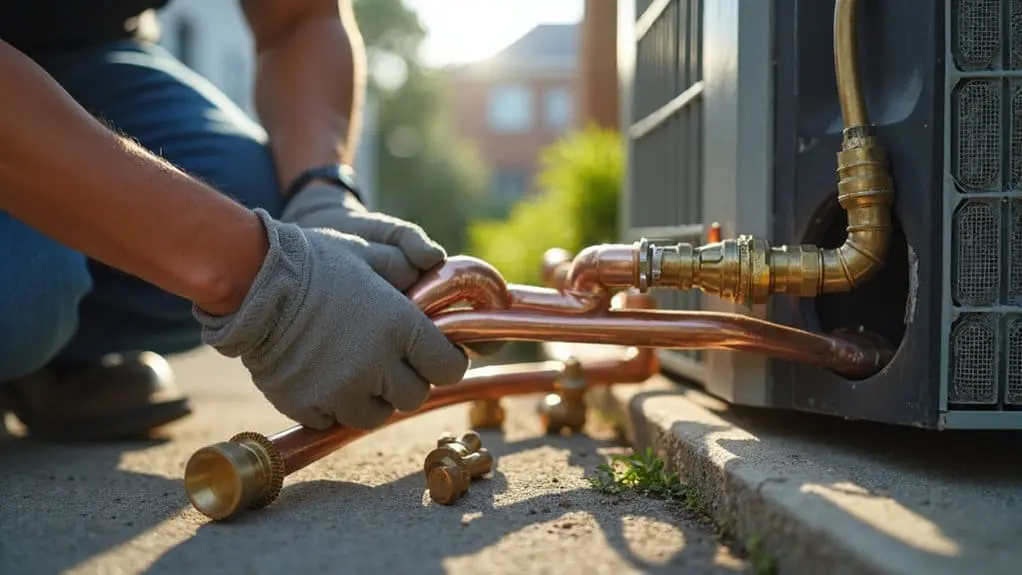
Central air conditioning installation begins with a certified technician conducting thorough load calculations and evaluating your home’s infrastructure. You’ll need existing system removal, including safe refrigerant recovery and electrical disconnection. The process involves preparing installation sites with proper gravel bases, installing new evaporator coils with custom plenums, setting up outdoor condensers with refrigerant lines, completing electrical connections, and installing condensate drainage systems. Each phase requires precise technical execution to confirm satisfactory performance and safety compliance throughout your system’s operational lifespan.
Key Takeaways
- A certified HVAC specialist conducts a thorough home assessment to determine proper unit sizing and placement requirements.
- Technicians safely remove the old system by recovering refrigerant and disconnecting electrical components using EPA-approved procedures.
- The installation site is prepared with a leveled gravel base and composite pad for optimal drainage and vibration absorption.
- The new evaporator coil is installed with custom sheet metal plenum construction and proper refrigerant line connections.
- Electrical connections are completed with new disconnect boxes while condensate drain lines are installed with appropriate slope.
In-Home Assessment and System Planning
Before installing your new central air conditioning system, a certified HVAC specialist must conduct a thorough in-home assessment to determine the precise specifications your home requires. This exhaustive home assessment evaluates your existing HVAC infrastructure, examining ductwork integrity, electrical capacity, and structural considerations that’ll impact installation.
The specialist performs a detailed load calculation, measuring your home’s square footage, insulation levels, window types, and occupancy patterns. This calculation determines the correct unit size—critical for ideal performance and preventing costly oversizing or undersizing issues.
Outdoor unit placement receives careful consideration, with the specialist identifying locations that meet code requirements while maintaining proper clearances from windows, doors, and property lines. They’ll discuss efficiency ratings and how different systems affect your comfort levels and operating costs.
Following this assessment, you’ll receive comprehensive system recommendations tailored to your home’s specific needs, ensuring maximum efficiency and long-term reliability.
Removing the Existing Air Conditioning System
Once your new system specifications are finalized, certified HVAC technicians begin the removal process by safely recovering all refrigerant from your existing air conditioning system using EPA-approved equipment and procedures. The refrigerant must be completely extracted using a recovery machine before any components can be disconnected. Only technicians with proper EPA certifications can remove the refrigerant from existing central air systems.
Next, they’ll disconnect the electrical wiring and replace your disconnect box and whip to guarantee secure safety for your new installation. The evaporator coil, located above or below your furnace, gets removed along with all refrigerant lines.
Your existing pad will be replaced since newer units are typically larger and taller. Technicians level the ground using a gravel base before installing the new pad, avoiding concrete which can crack and shift over time, potentially damaging your equipment.
Preparing the Installation Site and Replacing Equipment Pads
After removing your existing system, technicians will prepare the installation site by replacing your current equipment pad with a properly sized composite pad designed to accommodate modern units’ larger dimensions.
The installation process involves three critical steps:
- Ground preparation – Workers will create leveled ground using a gravel base to establish a stable foundation that prevents settling and secures proper drainage around your new system.
- Pad selection and sizing – A composite pad replaces your concrete pad because composite materials offer superior vibration absorption and resist cracking or shifting that commonly affects concrete over time.
- Precise positioning – The team will carefully position the new pad to support both the larger size and taller units characteristic of modern air conditioning systems.
Replacing existing pad infrastructure is essential because today’s equipment requires more robust support than older systems. The composite material’s flexibility accommodates thermal expansion while maintaining structural integrity, safeguarding your investment’s proper support throughout its operational lifespan.
Installing the New Indoor Evaporator Coil
The indoor evaporator coil installation represents the most technically demanding phase of your central air conditioning setup, requiring precise positioning and specialized connections to guarantee peak system performance. Select a cased coil for streamlined installation, positioning it above or below your furnace with adequate clearance from the furnace heat exchanger to prevent drain pan damage.
Construct a custom sheet metal plenum with an opening that precisely mirrors the coil’s bottom configuration, ensuring proper airflow distribution throughout your system. If your coil is plastic, implement protective measures to prevent galvanic corrosion where dissimilar metals contact the unit. Secure refrigerant line connections and verify access to the coil for future maintenance requirements.
Install the drain pan with appropriate slope for condensate removal. Confirm all required permits are obtained before finalizing connections. Test system pressures and airflow patterns to validate installation integrity before commissioning your new cooling system.
Setting Up the Outdoor Condenser Unit and Refrigerant Lines
Proper outdoor condenser unit positioning forms the foundation of your central air conditioning system’s long-term reliability and efficiency. You’ll need to place the unit on a level composite pad that absorbs vibrations and provides stable support.
Next, you’ll connect the outdoor condenser unit to your indoor evaporator coil using properly sized copper refrigerant lines. The system requires two lines: a larger suction line and a smaller liquid line. Here’s your installation checklist:
- Secure refrigerant lines every 4-6 feet using appropriate brackets
- Install a filter drier near the indoor coil to prevent system contamination
- Protect connections against galvanic corrosion between dissimilar metals
Before completing the installation, you must guarantee the refrigerant lines are pressure tested for leaks. The system must be thoroughly evacuated to remove moisture and air before adding the manufacturer-specified refrigerant charge. This systematic approach assures ideal performance and prevents costly repairs.
Electrical Connections and Condensate Drain Installation
With your refrigerant lines tested and secured, electrical connections become your next critical installation phase. Install the new service disconnect box within sight of your condenser unit. This fused box must contain a breaker matches your unit’s amperage requirements. Run electrical wire from the condenser to the disconnect, then continue to your home’s service panel. If your panel’s at capacity, you’ll need an upgrade before proceeding.
Connect the low-voltage control wire between your condensing unit and furnace, enabling proper thermostat to the furnace communication for system operation.
Next, install the Condensate Drain system. Your primary condensate Drain Line removes water produced during cooling. Route PVC pipe from the evaporator coil to either your basement floor drain or outside discharge point. Guarantee proper slope for gravity drainage and allow access to all connections for future maintenance. Test the drain system before completing your installation.
System Testing and Startup Commissioning
Before energizing your newly installed central air conditioning system, you must complete a thorough startup and commissioning process that validates every component’s performance against manufacturer specifications.
Your HVAC technician will execute this critical system testing phase through three essential steps:
- Leak Testing and Evacuation: Pressurize the refrigerant line with dry nitrogen to detect leaks, then pull a deep vacuum to eliminate air and moisture contamination.
- Refrigerant Charging: Add factory-recommended refrigerant amounts while monitoring refrigerant flow and refrigerant pressure readings to guarantee optimal performance.
- Operational Verification: Test the complete sequence of operation, including thermostat communication, fan operation, compressor cycling, and all safety controls activation.
During system startup, your technician will verify proper thermostat programming and demonstrate its features. This comprehensive commissioning ensures your central air conditioning system operates safely within design parameters, maximizing efficiency and longevity while preventing costly future repairs.
Conclusion
You’ve now completed the thorough installation process that typically requires 8-12 hours for a standard residential system. Remarkably, properly installed central air systems can reduce your energy consumption by up to 20% compared to outdated units. Don’t forget to schedule your initial maintenance check within 30 days—this crucial step guarantees ideal refrigerant levels, verifies electrical connections remain secure, and confirms your system’s operating pressures fall within manufacturer specifications. Your investment in professional installation pays dividends through heightened efficiency and durability.