
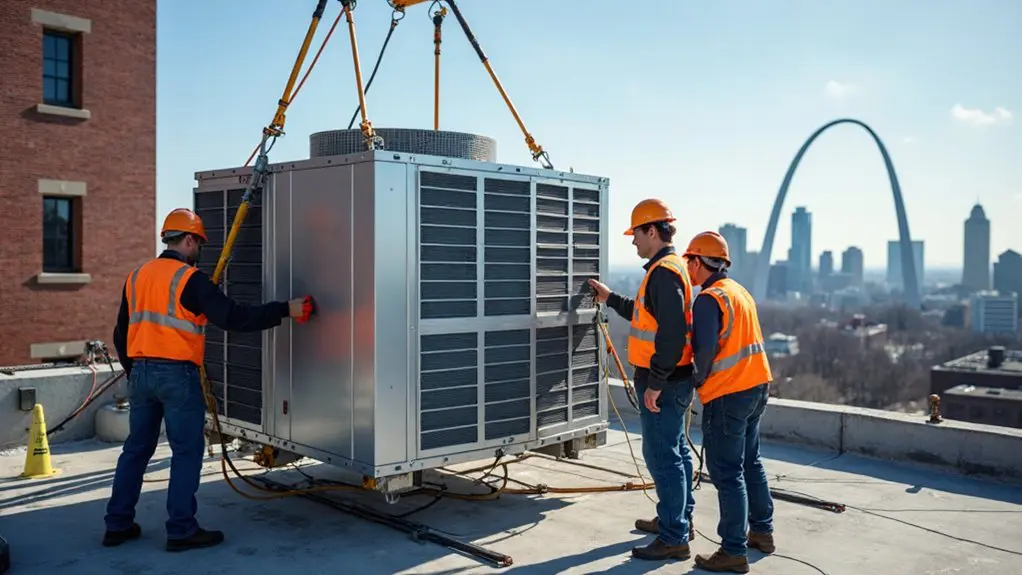
You’ll need specialized engineering for downtown St. Louis commercial AC installations that address urban heat island effects increasing ambient temperatures by 2-5°F, aging infrastructure constraints, and complex municipal permitting processes. Modern variable-speed systems deliver 20-40% energy cost reductions through precise load calculations accommodating irregular floor layouts and variable occupancy patterns. Professional installation requires systematic building assessment, proper system sizing, and performance verification testing to guarantee regulatory compliance and ideal efficiency. Complete solutions below detail advanced automation and maintenance protocols.
Key Takeaways
- Downtown St. Louis commercial HVAC installations require specialized urban expertise and extensive municipal permitting coordination.
- Energy-efficient AC systems deliver 20-40% cost reduction through variable-speed compressors and proper system sizing.
- Professional installation includes building assessment, precise technical configuration, and comprehensive performance verification testing.
- Advanced air quality solutions combat urban pollutants through filtration, humidity control, and UV purification technology.
- Maintenance programs extend equipment lifespan by 50% while reducing energy consumption up to 20%.
Understanding Downtown St. Louis Commercial HVAC Requirements
When you’re planning commercial AC installation in downtown St. Louis, you’ll encounter distinct requirements that differentiate urban projects from suburban installations. Your HVAC systems must accommodate aging building infrastructure, often featuring decades-old electrical and structural frameworks that require careful integration analysis.
Downtown commercial properties present complex load calculations due to variable occupancy patterns, diverse tenant needs, and irregular floor layouts. Your system design must account for heat island effects from surrounding concrete structures and limited roof space for equipment placement.
Permitting processes involve multiple municipal departments, requiring extensive documentation of structural modifications, electrical upgrades, and safety compliance measures. You’ll need specialized contractors familiar with confined workspace protocols and equipment hoisting restrictions in dense urban environments.
Commercial HVAC installations downtown demand precise load modeling to handle peak demands while maintaining energy efficiency targets. Your system specifications must address noise ordinances, aesthetic requirements for historic districts, and accessibility constraints that impact equipment selection and installation methodologies.
Energy-Efficient AC Systems for Office Buildings
Modern energy-efficient AC systems can reduce your downtown St. Louis office building’s energy costs by 20-40% while maintaining ideal comfort levels. Variable-speed compressors adjust cooling output based on real-time demand, eliminating energy waste from constant on-off cycling that plague traditional systems.
Proper HVAC system sizing prevents hot spots and energy inefficiency. Oversized units short-cycle, while undersized air conditioner units run continuously, both creating comfort issues and higher operating costs. Professional load calculations factor in building orientation, window placement, occupancy patterns, and thermal characteristics.
Advanced zoned climate control allows independent temperature management across different office areas. This targeted approach reduces energy consumption by cooling only occupied spaces during off-peak hours.
Regular maintenance protocols guarantee peak performance and extended equipment lifespan. Filter replacement, coil cleaning, and refrigerant level monitoring prevent efficiency degradation.
High-efficiency installations qualify for utility rebates and federal tax credits, offsetting initial investment costs while delivering long-term operational savings.
Professional Installation Process for Commercial Properties
Professional commercial AC installation requires systematic precision to guarantee satisfactory performance and regulatory compliance in downtown St. Louis. You’ll receive thorough service from our experienced technicians who execute proven methodologies for ideal system integration.
Our installation protocol follows these critical phases:
- Building Assessment Analysis – We conduct detailed evaluations of your property’s square footage, architectural layout, and thermal load requirements to engineer appropriate system specifications.
- Technical System Installation – Our certified team installs commercial units with precise electrical connections, ductwork integration, and refrigerant line configuration meeting industry standards.
- Performance Verification Testing – We execute thorough system testing protocols measuring airflow dynamics, temperature control accuracy, and energy efficiency metrics.
- Ongoing HVAC Maintenance Programs – You’ll receive structured maintenance schedules and technical support ensuring sustained performance optimization.
This systematic approach guarantees your commercial HVAC investment delivers measurable results. Our HVAC Services encompass complete lifecycle management, from initial installation through long-term operational support.
Indoor Air Quality Solutions for Urban Office Environments
Downtown St. Louis’s construction dust and traffic pollution directly compromise your office building’s indoor air quality, requiring targeted filtration solutions. You’ll need whole-home filtration systems that actively remove allergens, dust, and pollutants from your circulated air to maintain ideal indoor air quality standards.
Your HVAC system requires humidity control integration to combat St. Louis’s extreme seasonal variations—dry winters and humid summers that disrupt occupant comfort and health. UV purification technology disinfects your entire HVAC network, neutralizing mold spores, bacteria, and viruses that threaten clean air circulation.
Professional duct cleaning and air balancing services optimize your system’s performance by removing accumulated dust buildup and correcting airflow imbalances. These services directly enhance energy efficiency while improving air distribution throughout your downtown office space. Implementation of these integrated solutions guarantees your commercial property maintains superior indoor air quality despite challenging urban environmental conditions that consistently impact building performance.
Maintenance Programs for Commercial AC Systems
Structured maintenance programs form the backbone of commercial AC system reliability, delivering measurable performance improvements that directly impact your bottom line. An extensive maintenance agreement provides systematic oversight that transforms reactive repairs into predictable operational costs.
Professional HVAC service protocols deliver quantifiable results through strategic interventions:
- Proactive Component Care – Regular filter changes, coil cleanings, and system tune-ups extend equipment lifespan by up to 50%, maximizing your infrastructure investment.
- Energy Optimization – Preventative maintenance reduces energy consumption by up to 20%, delivering substantial cost savings through improved system efficiency.
- 24/7 Emergency Response – Dedicated technicians provide round-the-clock support, identifying potential failures before they escalate into costly breakdowns.
- Customized Service Plans – Tailored maintenance schedules account for building size, occupancy patterns, and usage demands, ensuring ideal performance for your specific operational requirements.
Strategic maintenance agreements eliminate guesswork while providing measurable returns on your commercial HVAC investment.
Cost-Effective Climate Control for Business Operations
Cost-effective climate control transforms your business operations through strategic HVAC system design that balances performance requirements with operational budgets. Your downtown St. Louis facility requires heating and cooling systems engineered for ideal energy distribution while minimizing operational expenses.
Climate Solutions’ commercial HVAC installations deliver measurable cost reductions through precisely calibrated air distribution networks. These systems eliminate energy waste by maintaining consistent temperatures across all building zones, reducing utility consumption and operational overhead. Your business benefits from expert engineering that matches system capacity to actual building demands rather than oversized installations that drain resources.
Strategic preventative maintenance agreements extend equipment lifespan while preventing costly emergency repairs. Regular system tuning maintains peak efficiency ratings, ensuring your heating and cooling infrastructure operates at designed performance levels. Professional HVAC design eliminates common inefficiencies like temperature fluctuations and inadequate airflow that force systems to work harder, consuming unnecessary energy and increasing operational costs for your business operations.
Advanced Building Automation and Smart Controls
Advanced building automation systems revolutionize your commercial HVAC operations by integrating intelligent controls that monitor, analyze, and maximize performance in real-time. These sophisticated platforms transform your heating and air conditioning infrastructure into a responsive, data-driven ecosystem that adapts to occupancy patterns and environmental conditions.
Smart controls deliver thorough facility management through:
- Remote Monitoring Capabilities – Access climate, ventilation, and system diagnostics from any location, enabling immediate adjustments to changing operational demands.
- Automated Scheduling Protocols – Program setpoints and operational schedules that eliminate energy waste during unoccupied periods while maintaining ideal comfort levels.
- Predictive Analytics Integration – Real-time diagnostics identify potential equipment failures before they occur, enabling proactive maintenance strategies that prevent costly disruptions.
- Centralized Control Interface – Seamlessly integrate with existing infrastructure through intuitive dashboards that provide complete visibility across your entire facility’s heating and air conditioning systems.
Emergency Service and 24-Hour Support Options
When critical HVAC failures strike your commercial facility outside standard business hours, you need immediate access to qualified technicians who can restore operational stability. Climate Solutions’ 24/7 emergency service guarantees your downtown St. Louis building maintains optimal operational parameters regardless of when system malfunctions occur.
Our around-the-clock response protocol activates experienced technicians who diagnose heating, furnace and air conditioning failures with precision-based troubleshooting methodologies. Whether you’re experiencing complete system shutdowns, refrigerant leaks, or control system errors, our emergency hotline connects you directly to qualified personnel equipped with diagnostic tools and replacement components.
The assured rapid response framework minimizes costly downtime while maintaining temperature specifications for tenant comfort and equipment protection. Our on-call staff maintains comprehensive knowledge of commercial HVAC systems, enabling efficient problem resolution during critical after-hours situations. This emergency support infrastructure protects your facility’s operational continuity and prevents revenue losses from extended system outages.
Conclusion
You’re traversing the concrete jungle of downtown St. Louis, where your commercial AC system serves as the backbone of operational efficiency. You’ll achieve ideal performance through precision-engineered installations, data-driven maintenance protocols, and integrated building automation systems. Your investment in professional HVAC solutions delivers measurable ROI through reduced energy consumption, enhanced indoor air quality metrics, and minimized downtime. You’re positioning your facility for sustained operational excellence in Missouri’s demanding urban climate conditions.