
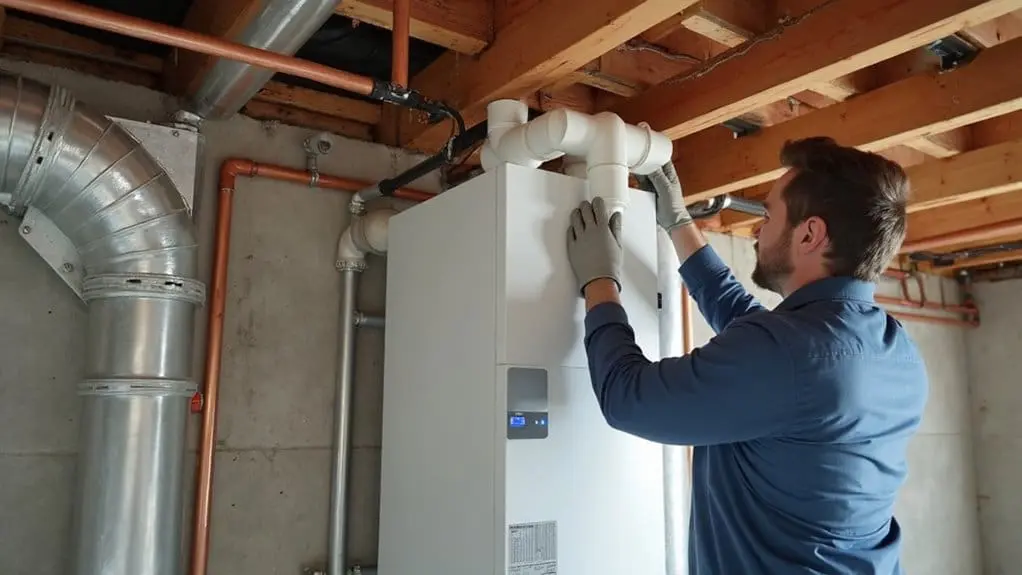
You’ll need professional installation for whole-house humidifiers, which integrate directly into your HVAC system to maintain ideal humidity levels throughout your home. Equipment costs range from $100-$1,100 depending on bypass, fan-powered, or steam models, with installation adding $400+ for proper water line connections and electrical work. These systems improve air quality, reduce heating costs by up to 4%, and require annual maintenance of $75-$200. This thorough approach guarantees you’ll understand every vital aspect of the installation process.
Key Takeaways
- Whole-house humidifiers improve air quality, respiratory health, and heating efficiency by maintaining ideal humidity levels through HVAC integration.
- Three main types include bypass, fan-powered, and steam humidifiers, with costs ranging from $100-$1,100 depending on system complexity.
- Pre-installation requires evaluating HVAC capacity, ductwork configuration, water supply access, and calculating your home’s specific humidity needs.
- Professional installation involves furnace mounting, plumbing connections, electrical wiring, and ductwork modifications requiring specialized expertise to ensure code compliance.
- Total investment ranges $500-$2,000 including equipment and installation, with annual maintenance costs of $75-$200 to maximize system lifespan.
Benefits of Whole-House Humidifiers for Your Home
Installing a whole-house humidifier delivers measurable improvements to your home’s air quality and overall comfort. Through seamless HVAC integration, these systems maintain ideal humidity levels throughout your living space, eliminating the respiratory health issues caused by dry air. The installation process enables your heating system to operate more efficiently, as properly humidified air feels warmer at lower temperatures, directly improving energy efficiency.
You’ll notice immediate comfort benefits as static electricity disappears and wood furniture stops cracking. The controlled moisture distribution protects your home’s interior elements from warping while creating an environment that supports better breathing. Your HVAC system works less intensively when humidity levels remain balanced, reducing energy consumption. This thorough approach to indoor air management transforms your entire home into a more comfortable, healthier living environment.
Types of Whole-House Humidifiers and Their Features
The three primary categories of whole-house humidifiers each operate through distinct mechanisms to deliver moisture throughout your home’s ductwork system. Bypass humidifiers connect to your furnace or HVAC system, using existing airflow to evaporate water and maintain ideal moisture levels. Fan-powered humidifiers incorporate an internal fan that enhances air circulation beyond what your standard system provides, making them more efficient for moderate-sized homes. Steam humidifiers boil water directly, creating steam that doesn’t depend on furnace airflow, delivering consistent humidity regardless of your heating system’s operation. Your home size determines the appropriate selection—bypass models suit smaller spaces, while fan-powered and steam units handle larger areas effectively. Steam humidifiers require minimal maintenance compared to other types, though all whole-home humidifiers need regular attention to water quality and component cleaning for safe whole house humidifier installation.
Pre-Installation Planning and System Compatibility
Before you proceed with installation, proper planning guarantees your whole-house humidifier integrates seamlessly with your existing systems and meets your home’s specific moisture requirements.
Your pre-installation assessment must address critical compatibility factors:
- Evaluate your existing HVAC system’s capacity – verify it can handle additional moisture load without compromising performance
- Assess ductwork configuration – confirm straight trunk runs of at least 1.8m for ideal installation location placement
- Examine water supply accessibility – determine if plumbing connections are available or if tank-style units better suit your setup
- Review local codes and regulations – confirm compliance with municipal humidity control requirements
- Calculate your home’s specific humidity requirements – match whole home humidifier output to your square footage and climate needs
Thorough compatibility verification prevents costly modifications and ensures your whole-house humidifiers operate efficiently within your HVAC system’s parameters.
Step-by-Step Installation Process
How do you transform your planning into a functional whole-house humidifier system? Installing a whole-house humidifier follows a precise sequence that determines whether you’ll DIY or hire professionals. Most bypass and fan-powered units require professional installation due to electrical and water line connections.
| Installation Phase | Professional Required |
|---|---|
| Furnace or air handler mounting | Yes – HVAC expertise needed |
| Water line connection | Yes – Plumbing skills required |
| Electrical wiring | Yes – Licensed electrician |
| Ductwork modifications | Yes – Proper airflow critical |
Proper installation begins with securing the unit to your furnace or air handler, followed by connecting the water supply line. Labor costs typically range from $300-600, considerably impacting total installation cost. When installing a humidifier, guarantee it’s installed correctly by following manufacturer specifications and local codes for ideal performance and safety.
Cost Breakdown and Budget Considerations
While installation represents just one aspect of ownership, understanding the complete financial picture helps you make informed decisions about your whole-house humidifier investment.
Your whole system cost breakdown includes several key components:
- Equipment costs: Bypass units ($100-$300) versus steam systems ($300-$1,100) – choose based on your specific humidity levels need
- Professional installation: $400+ additional cost but prevents water damage and guarantees proper setup
- Annual maintenance cost: $75-$200 yearly to keep your system functioning ideally
- Energy expenses: Variable costs depending on humidifier type – monitor humidity settings to maximize efficiency
- Long-term value: Cost of a new system ranges $500-$2,000, but proper maintenance extends lifespan tremendously
Labor typically accounts for 50% of total installation expenses, varying by geographic location and complexity.
Maintenance Requirements and Professional Vs DIY Installation
After investing in your whole-house humidifier system, you’ll face a critical decision that impacts both performance and safety: whether to handle installation yourself or hire qualified HVAC professionals. Professional installation guarantees proper drainage setup, code compliance, and ideal performance for both drum and flow-through systems. While DIY installation saves approximately $400, it risks voiding your manufacturer’s warranty and creating costly issues.
Regardless of installation method, regular maintenance remains essential. You’ll need to replace water panels in flow-through units or clean filters in drum humidifiers seasonally. Professional installation provides proper system integration and prevents water damage through correct placement and drainage configuration. HVAC professionals can also recommend appropriate humidifier types—drum or flow-through—based on your home’s specific requirements, ensuring long-term efficiency and warranty protection.
Conclusion
You’ve now mapped the complete installation blueprint—think of it like assembling a precision instrument where each component must align perfectly. According to EPA data, properly installed whole-house humidifiers maintain 30-50% humidity levels consistently. You’ll need to follow manufacturer torque specifications exactly, guarantee electrical connections meet code requirements, and schedule annual maintenance. Don’t skip the calibration phase; it’s your safety net against over-humidification damage. Professional installation remains the gold standard for warranty protection.