
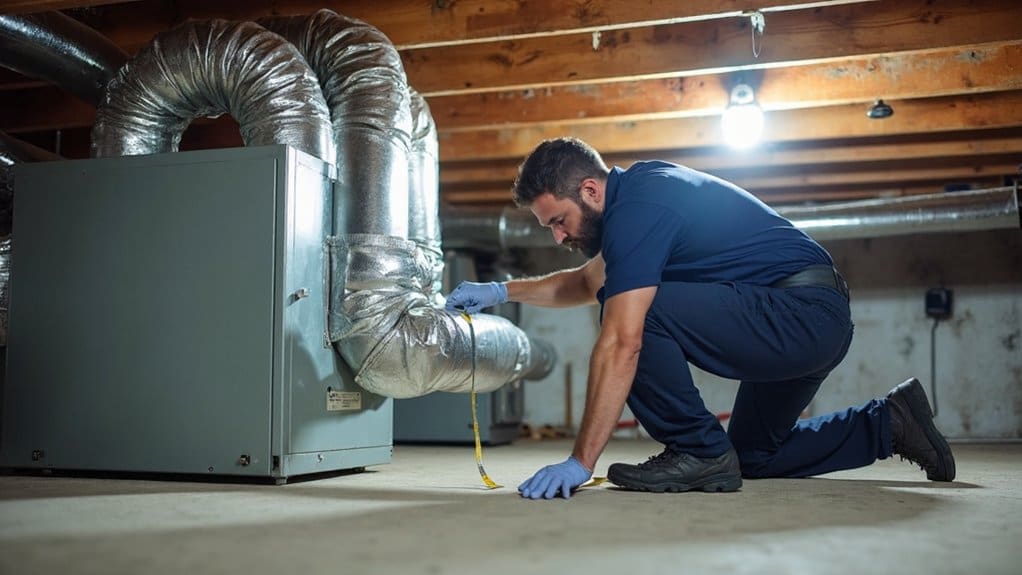
You’ll need to assess your existing ductwork’s size, materials, and layout to guarantee compatibility with your new furnace’s airflow requirements. Proper sizing using Manual D calculations prevents efficiency losses from undersized or oversized ducts. You must seal all joints with mastic or foil tape and insulate ducts in unconditioned spaces to prevent energy waste. Don’t forget adequate return air sizing—it should equal 60-100% of your supply ductwork capacity. Understanding these fundamentals will help you navigate the complete installation process successfully.
Key Takeaways
- Assess existing ductwork size, materials, and airflow capacity to ensure compatibility with new furnace specifications.
- Calculate proper duct dimensions using Manual D to match furnace airflow and prevent efficiency losses.
- Route ducts through conditioned spaces and insulate those in unconditioned areas to minimize energy loss.
- Size return air system at 60-100% of supply ductwork capacity to prevent airflow restrictions.
- Seal all duct joints with mastic or foil tape to improve system efficiency by up to 20%.
Assessing Existing Ductwork Compatibility
When installing a new furnace, you’ll need to evaluate your existing ductwork’s compatibility before proceeding with the installation. Your HVAC system’s performance depends heavily on properly sized and configured air ducts that match your new furnace’s airflow requirements.
Start by examining the size, shape, and layout of your current duct system. Measure each duct run to guarantee they can handle the new unit’s capacity. Check if your HVAC ductwork uses appropriate materials and adequate insulation throughout the system.
You’ll also want to test static pressure and airflow at every register to identify restrictions or imbalances in your existing ductwork. These measurements reveal whether your duct installation meets modern efficiency standards.
If your air ducts are outdated or poorly designed, you might need complete replacement to achieve ideal heating performance. Consider consulting an HVAC professional who can thoroughly assess your duct system and recommend necessary modifications for seamless integration with your new furnace.
Proper Duct Sizing for New Furnace Capacity
After determining your existing ductwork’s compatibility, you’ll need to focus on proper sizing to match your new furnace’s capacity. Your HVAC professional will use Manual D calculations to determine the correct duct dimensions based on your home’s size, insulation levels, and heating system output.
Undersized ducts restrict air movement, creating hot and cold spots throughout your home while forcing your heating and cooling system to work harder. This reduces energy efficiency and creates excessive noise. Conversely, oversized ducts waste energy and increase installation costs without providing benefits.
Round duct diameter and rectangular duct width and height must precisely match your furnace’s airflow requirements. Your contractor will calculate the proper sizes for main trunks and individual branches to guarantee adequate air reaches each room.
Working with an experienced HVAC professional during installation guarantees your ductwork delivers optimal system performance, energy efficiency, and comfortable temperatures throughout your home.
Strategic Duct Placement and Routing
Beyond proper sizing, strategic ductwork placement and routing directly impact your heating system’s performance and energy costs. Your ductwork design should prioritize routing through conditioned spaces whenever possible. Ducts in unconditioned areas like unheated attics or crawl spaces lose substantial heat, forcing your furnace to work harder.
When planning your ductwork system, guarantee all ducts are properly insulated, especially those passing through unconditioned air spaces. Insulated ducts prevent temperature loss and condensation issues that compromise efficiency. Your Ductwork Installation should incorporate gradual turns and bends rather than sharp angles, maintaining smooth airflow and preventing static pressure buildup.
Strategic register placement assures balanced air distribution throughout your home. Position supply and return registers thoughtfully to create proper air circulation patterns. Seal all joints and connections in your proper ductwork system to prevent air leaks. These routing decisions during installation will significantly impact your system’s long-term performance and operating costs.
Return Air System Requirements
While supply ducts deliver heated air throughout your home, your return air system serves as the critical pathway that brings air back to your furnace for reheating and recirculation. Without proper return air design, you’ll experience air pressure imbalances that strain your air handler and reduce overall system efficiency.
Each room needs at least one return air grille to maintain adequate airflow back to your furnace. You’ll want your total return air grille square footage to equal 60-100% of your supply ductwork size. Undersized return ducts create negative pressure that restricts airflow and forces your air handler to work harder.
Strategic placement of return air grilles promotes even air circulation throughout your home. Position them away from supply registers to prevent short-cycling, and avoid blocking them with furniture. Poor return air design leads to air stagnation, humidity problems, and uneven temperatures that compromise your comfort and energy efficiency.
Duct Sealing and Insulation Standards
Even with perfectly designed ductwork, you’ll lose substantial heating capacity if your ducts aren’t properly sealed and insulated. During installation, ductwork and other HVAC components require professional sealing to prevent energy waste. You can improve your system’s efficiency by up to 20% through proper joint sealing using mastic or foil tape.
Your HVAC unit loses up to 40% of its heating or cooling capacity when duct systems remain uninsulated, particularly in unconditioned spaces like attics and crawl spaces. The Department of Energy recommends R-8 or higher insulation values for optimal performance, whether you’re installing a heat pump or traditional furnace system.
The Sheet Metal and Air Conditioning Contractors of America provides detailed standards for proper sealing techniques. Regardless of the type of ductwork you choose, following these professional guidelines guarantees maximum efficiency and comfort while reducing utility costs throughout your system’s lifespan.
Balancing Supply and Return Airflow
After sealing and insulating your ductwork, you must achieve proper airflow balance between your supply and return ducts to maximize system performance. When your heating and cooling system has unbalanced airflow, you’ll experience comfort issues throughout your home, with some rooms feeling too hot or cold.
Improper return airflow creates pressure imbalances that force your HVAC systems to work harder, leading to higher energy bills and reduced equipment lifespan. Insufficient return air reduces airflow circulation, causing poor air quality and uneven heating or cooling distribution.
Your HVAC professional should measure airflow using specialized tools and calculations to guarantee proper sizing and configuration. They’ll adjust dampers and modify ductwork as needed to reach ideal balance. This process guarantees conditioned air circulates evenly throughout every room.
Regular airflow balance inspections help maintain peak system efficiency. Properly balanced supply and return airflow prevents air leaks, reduces energy waste, and extends your furnace’s operational life while maintaining consistent indoor comfort.
Material Selection for Ductwork Components
Beyond achieving proper airflow balance, you’ll need to select the right materials for your ductwork components to guarantee long-term system performance. Sheet metal ducts, made from galvanized steel or aluminum, offer exceptional durability and easy configuration for your heat distribution system. They’re ideal for main trunk lines but require skilled installation throughout parts of your home.
Flex ducts provide installation convenience, especially in tight spaces where your air conditioner connects to various rooms. However, they’re less efficient over long distances and can restrict airflow if improperly installed.
Fiberboard ducts deliver excellent insulation properties, reducing heat loss and condensation issues within your entire system. Unfortunately, they’re more fragile and need careful handling during installation.
While flexible options typically cost less upfront, consider long-term efficiency and maintenance requirements. Your HVAC professional will evaluate your home’s layout, airflow needs, and budget constraints to recommend the most appropriate materials for ideal system performance and energy efficiency.
Installation Best Practices and Professional Standards
When it comes down to professional ductwork installation, your contractor must adhere to established industry standards that guarantee peak system performance. Following Sheet Metal and Air Conditioning Contractors’ National Association (SMACNA) guidelines confirms proper design and sizing for your common ductwork system. Experienced professionals educate our customers about ACCA’s Manual D calculations, which determine ideal duct sizes based on your home’s specific requirements.
Your contractor should seal all joints with mastic or foil tape to prevent air leaks that cause higher energy consumption and inflated utility bills. Proper insulation in unconditioned spaces maintains temperature control and maximizes energy efficiency. Strategic placement of supply vents and an adequate number of return air openings creates balanced airflow throughout your home.
Professional installation guarantees your ductwork system operates at maximum efficiency, reducing operational costs while maintaining consistent comfort levels in every room of your house.
Cost Factors and Budget Planning
Understanding the financial investment required for ductwork replacement helps you make informed decisions about your furnace installation project. You’ll typically spend $2,000 to $5,000 depending on your home’s size and complexity. The main duct system’s condition notably affects pricing, as damaged sections that allow heated or cooled air to escape require immediate attention.
Several factors influence your budget. The number of different parts needing replacement, installation difficulty accessing cramped spaces, and structural repairs all impact costs. When contaminated air can enter the system through leaky joints, you’ll face pressure drop issues that reduce efficiency and increase expenses.
Energy-efficient upgrades cost more upfront but improve how your system works to heat and cool your home while reducing utility bills. Your indoor air quality also benefits from properly sealed ductwork. Getting multiple contractor quotes helps you compare prices and find the best value for bundling ductwork replacement with your furnace installation.
Frequently Asked Questions
What Is a Common Mistake in Ductwork Installation?
You’ll often see improper duct sizing as the biggest mistake. Poor ductwork layout, inadequate duct insulation, and incorrect duct sealing follow closely. These errors cause airflow problems, energy loss, and system inefficiency.
What Is the 2 Foot Rule for Ductwork?
Picture air dancing through your home’s veins. You’ll maintain 2-foot separation between supply and return ducts, ensuring proper airflow distribution. This prevents short-circuiting, optimizes register placement, and works with balancing dampers for efficient circulation.
When Installing Ductwork, We Must Insulate the Ductwork When It’s Installed in a ____.?
You’ll need to insulate ductwork when it’s installed in an uninsulated space. Proper insulation levels and duct sealing techniques guarantee system efficiency optimization, while thoughtful ductwork configuration planning reduces air leakage for maximum performance.
What to Expect During Furnace Installation?
You’ll experience some temporary home disruption during installation. Expect proper equipment sizing assessments, ductwork inspection processes, venting considerations, thermostat placement decisions, sealing importance, air quality impacts, energy efficiency concerns, and zoning system integration discussions.
Conclusion
You’ll want to remember that poorly designed ductwork can waste up to 30% of your heating energy, according to ENERGY STAR studies. Don’t let inadequate planning turn your new furnace investment into higher utility bills. You’ve learned the critical steps – from evaluating compatibility to proper sealing techniques. Now you’re equipped to work with professionals who’ll guarantee your ductwork maximizes efficiency and comfort while safeguarding your long-term energy costs.