
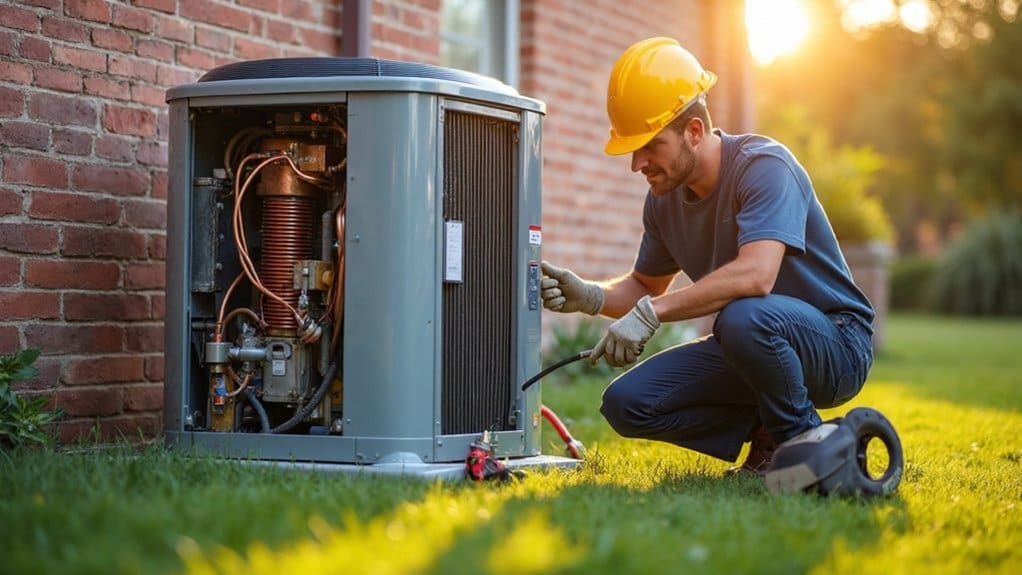
You’ll typically spend $4,000 to $8,000 for air-source heat pumps, $2,000 to $7,000 for ductless mini-splits, or $10,000 to $30,000 for geothermal systems. Your final cost depends on your home’s size, existing ductwork condition, efficiency ratings you choose, and local labor rates. Don’t forget additional expenses like electrical upgrades ($500-$3,000), permits, and potential ductwork modifications that can double your project budget. Understanding these cost factors will help you make informed decisions for your specific situation.
Key Takeaways
- Heat pump installation costs range from $2,000-$7,500 for mini-splits to $10,000-$30,000 for geothermal systems.
- Home size significantly impacts budget: expect $17,000-$23,000 for smaller homes, $26,000-$30,000 for larger properties.
- Additional expenses include electrical upgrades ($500-$3,000), ductwork modifications, permits ($100-$500), and site preparation costs.
- Higher efficiency ratings increase upfront costs but provide greater long-term energy savings to offset expenses.
- Regional factors like climate conditions, local labor rates, and seasonal pricing fluctuations affect total installation budgets.
Average Heat Pump Installation Costs by System Type
When choosing a heat pump for your home, understanding installation costs by system type helps you make an informed decision that fits your budget and heating needs.
Air-source heat pump installation typically ranges from $4,000 to $8,000, delivering excellent performance without breaking the bank. These systems offer the best balance between upfront costs and efficiency for most homeowners.
Ductless mini-split heat pumps cost between $2,000 and $7,000 to install, making them perfect for smaller spaces or homes lacking existing ductwork. They’re often the most affordable option for targeted heating and cooling.
Geothermal heat pumps require the highest initial investment at $10,000 to $30,000, but they’ll deliver substantial long-term energy savings that offset installation costs over time.
Your heat pump costs depend on several cost factors including your home’s size, system efficiency ratings, and installation complexity. Consider both the cost of a heat pump system and potential energy savings when evaluating your options.
Key Factors That Drive Heat Pump Installation Expenses
Several key factors tremendously impact your heat pump installation expenses beyond the basic system type. Your home size directly determines the heating/cooling capacity requirements, with larger properties needing high-capacity systems costing $4,000 to $7,300. Efficiency ratings also play an essential role—higher SEER and HSPF ratings deliver better energy savings but increase upfront installation costs from $1,600 to $9,500.
Understanding these cost drivers helps you budget effectively for your heat pump project:
- Home size and capacity needs – Larger homes require more expensive, high-capacity units
- Efficiency ratings – Higher SEER/HSPF ratings cost more initially but provide greater energy savings
- Existing ductwork condition – Repairs or replacements greatly increase total expenses
- Regional climate conditions – Extreme temperatures may require specialized equipment
- Local labor rates and market competition – HVAC contractor pricing varies extensively by geographic area
These factors can cause installation costs to fluctuate dramatically across different regions and home configurations.
Air Source vs. Geothermal vs. Mini-Split: Cost Breakdown
Understanding the three main heat pump types will help you make an informed decision based on your budget and specific needs. Air source heat pumps offer moderate installation costs between $3,500-$8,000 and work effectively in temperate climates with straightforward setup requirements.
Mini-split heat pumps present the most budget-friendly option at $2,000-$7,500, featuring ductless installation that’s ideal for individual rooms or smaller home size applications. They require only a small wall opening, making installation remarkably simple.
Geothermal heat pumps demand the highest upfront cost at $10,000-$25,000 due to extensive ground loop installation. However, they deliver superior energy efficiency across all climate conditions and provide substantial long-term energy savings that offset initial expenses.
Your choice depends on balancing installation cost against performance expectations. Consider your climate, home size, and energy efficiency goals when evaluating each heat pump type’s total value proposition for your specific situation.
Hidden Costs and Additional Expenses to Consider
Beyond the baseline installation quotes, you’ll encounter numerous additional expenses that can substantially increase your total heat pump project cost. These hidden costs often catch homeowners off-guard, making proper budgeting essential for your project’s success.
- Electrical upgrades – Your home may need panel upgrades or new circuits to handle the heat pump’s power requirements, adding $500-$3,000 to labor costs
- Ductwork modifications – Existing ductwork might require sealing, resizing, or complete replacement, potentially doubling your total project expenses
- Permits and inspections – Local requirements vary, but expect $100-$500 in additional fees that affect your project costs
- Site preparation – Concrete pads, trenching, or landscaping restoration can add unexpected expenses to equipment and installation
- Seasonal pricing fluctuations – Local labor rates increase during peak seasons, impacting your total investment
Research available rebates or incentives and explore financing options to offset these additional costs while ensuring proper installation.
How Home Size and Climate Impact Your Installation Budget
While your heat pump’s upfront costs depend heavily on equipment selection and installation complexity, your home’s square footage and local climate conditions will ultimately determine the largest portion of your budget.
Your home size directly impacts installation costs through capacity requirements. Expect to pay $17,000-$23,000 for 1,500-2,500 sq ft homes, $22,500-$28,000 for 2,500-5,500 sq ft properties, and $26,000-$30,000 for homes exceeding 5,500 sq ft.
Climate substantially influences your heating and cooling needs. Moderate climates with well-insulated homes require less capacity, reducing costs compared to extreme climates. Regional variations also affect pricing through supply chain constraints and contractor availability.
You can minimize upfront costs by improving energy efficiency before installation. Conducting energy audits and implementing weatherization measures reduces your required heat pump capacity. However, factor in potential electrical upgrades—older homes may need panel or wiring improvements to handle increased energy demands, adding to your overall investment.
Ductwork Modifications and Electrical Upgrade Costs
Most heat pump installations require modifications to your home’s infrastructure, creating additional costs that can considerably impact your total budget. Your existing HVAC system may need significant upgrades to accommodate a new heat pump’s requirements.
Ductwork modifications often become necessary when your current system has leaks or improperly sized ducts. These repairs can add $500 to $5,000 to your installation cost. Additionally, homes with outdated electrical panels frequently require an electrical service upgrade, adding another $1,000 to $3,000 to your budget.
Key factors affecting your upgrade costs include:
- Age and condition of your existing HVAC system
- Current electrical capacity versus heat pump requirements
- Extent of ductwork repairs or replacements needed
- Home’s infrastructure complexity and accessibility
- Local building codes and permit requirements
Proper ductwork and adequate electrical capacity guarantee your heat pump will operate efficiently and deliver expected energy savings. An experienced HVAC contractor can assess your system and identify all necessary ductwork and electrical modifications before installation begins.
Labor Rates and Regional Price Variations
Although heat pump installation may seem standardized, labor rates fluctuate dramatically based on your geographic location and local market conditions. Regional price variations stem primarily from cost of living differences, with metropolitan areas typically commanding higher rates for HVAC services than rural regions.
Your location’s heating or cooling season length also affects pricing. Areas requiring year-round climate control often see increased installation complexity, driving up labor costs. The availability of local HVAC contractors plays a pivotal role—limited competition in the market can inflate prices, while saturated markets may offer more competitive rates.
Building codes and permitting requirements vary greatly by region, potentially adding substantial costs to guarantee compliance. Additionally, you’ll encounter regional factors like transportation expenses for equipment delivery, material supply chain challenges, and varying local taxes or fees. These combined elements can create price differences of 30-50% between different geographic areas for identical heat pump installations.
Government Rebates, Tax Credits, and Financing Options
Beyond regional pricing differences, you can substantially reduce your heat pump installation costs through various government incentives and financing programs. Federal tax credits offer up to 30% back on your system and installation expenses for energy-efficient home improvements. Many states and utilities provide rebates ranging from $500 to $2,000 or more, directly offsetting upfront costs.
Low-interest financing makes heat pump installations more accessible through several options:
- HVAC loans – Specialized financing for heating and cooling systems
- Home equity loans – Leverage your home’s value for better rates
- Federal tax credits – Claim up to 30% of total project costs
- State and utility rebates – Receive direct cash back incentives
- Combined savings – Stack multiple incentives for maximum benefit
You’ll maximize cost-effectiveness by researching all available local, state, and federal programs before installation. These financing options and tax credits can dramatically reduce your overall investment, making the conversion to efficient heating and cooling financially manageable.
Long-Term Energy Savings and Return on Investment
While the upfront costs of heat pump installation might appear challenging, you’ll recover your investment through substantial energy savings over time. Heat pumps deliver up to 40% annual energy savings compared to traditional HVAC systems, helping you diminish utility bills significantly. This exceptional energy efficiency makes heat pumps a cost-effective investment that can offset initial investment costs within several years.
Geothermal heat pumps offer the highest efficiency ratings, providing maximum long-term energy savings despite their higher installation costs. You can expedite your payback period by taking advantage of available rebates and incentives from states and utility companies.
To optimize energy efficiency and extend lifespan, guarantee proper system sizing and commit to regular maintenance. These practices enhance performance and contribute to your heat pump’s overall return on investment. When you factor in reduced monthly utility costs and available financial incentives, the upfront installation costs become a smart financial decision that pays dividends for decades.
Money-Saving Tips for Heat Pump Installation Projects
Several strategic approaches can dramatically reduce your heat pump installation costs without compromising system quality or performance. These money-saving strategies can make your project more affordable while maximizing your long-term savings.
Smart cost-reduction tactics include:
- Maximize financial incentives – Research available tax credits, rebates, and utility incentives that can slash thousands off your upfront investment
- Choose ductless mini-split systems – These units typically cost less to install than central systems, especially when you lack existing ductwork
- Invest in weatherization first – Improve energy efficiency through air sealing and insulation, allowing you to install a smaller, less expensive heat pump
- Explore financing options – Consider low-interest loans or leasing programs to spread costs over time
- Schedule off-season installation – Book during slower periods when contractors offer discounts and promotions
These strategic decisions can significantly reduce your total project cost while ensuring ideal performance.
Frequently Asked Questions
What Is the Average Cost for a Heat Pump Installation?
You’ll pay $4,500-$10,000 for heat pump installation. Consider system size selection, energy efficiency ratings, ductwork requirements, electrical upgrades, and rebate programs. Climate adaptability, zoning considerations, thermostat integration, and refrigerant regulations affect your final costs.
How Much Is a Heat Pump for a 2000 Square-Foot House?
You’ll spend $4,000-$8,000 for your 2,000-square-foot home, but here’s what’s surprising: proper system capacity sizing can reduce costs by 20%. Consider energy efficiency ratings, climate zone considerations, and rebate opportunities when selecting heat pump models.
What Is the Most Expensive Part of a Heat Pump?
The compressor cost typically represents your most expensive heat pump component. However, you’ll find installation complexity, electrical upgrades, and ductwork modifications often exceed equipment costs, especially when system efficiency requirements demand larger equipment size and specialized labor rates.
How Much Should I Spend on a Heat Pump?
Don’t put all your eggs in one basket—consider energy efficiency ratings, system size requirements, manufacturer reputation, and HVAC contractor expertise when budgeting $4,500-$10,000, factoring government incentives and long-term energy bill savings.
Conclusion
You’ll face upfront costs ranging from $4,000 to $20,000, but here’s what should motivate you: heat pumps can slash your heating bills by up to 65% compared to traditional systems. That’s potentially thousands saved annually. Don’t let sticker shock deter you—between federal tax credits, local rebates, and long-term energy savings, you’re making an investment that’ll pay dividends for decades. Start researching contractors now and secure your energy-efficient future.