
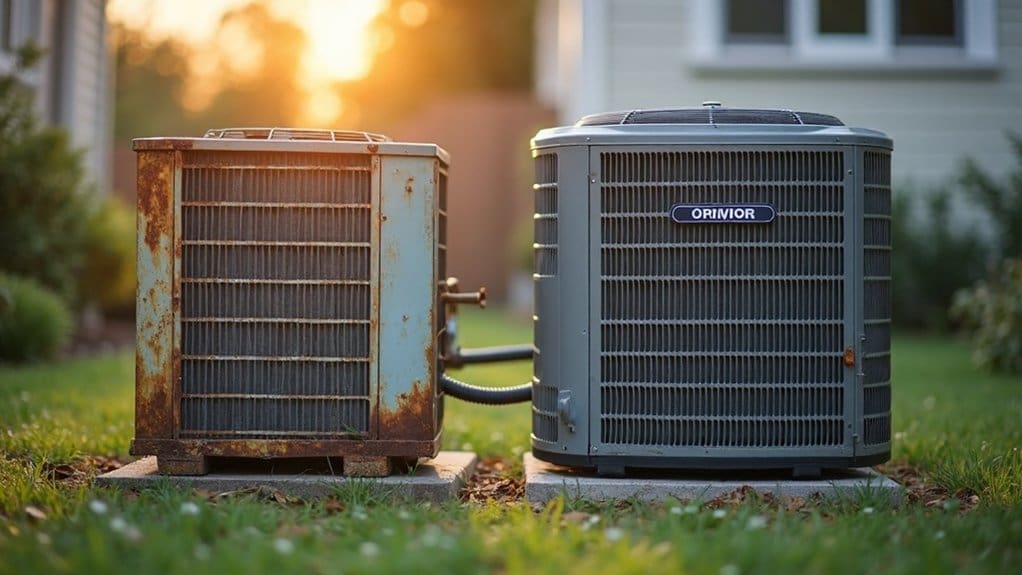
You should repair your heat pump if it’s under 10 years old and repair costs are reasonable, but consider replacement if your unit’s over 15 years old or repairs exceed 50% of a new system’s price. Signs like unusual noises, reduced airflow, and spiking energy bills indicate professional attention is needed. Frequent breakdowns and declining efficiency typically warrant replacement, while newer units offer improved energy savings and warranty protection. The factors below will help guide your specific situation.
Key Takeaways
- Heat pumps over 15 years old should typically be replaced due to declining efficiency and approaching end of useful lifespan.
- Replace your heat pump when repair costs exceed 50% of a new system’s price or require multiple annual repairs.
- Units under 10 years old are usually worth repairing, while 10-15 year old systems require careful cost-benefit analysis.
- New heat pumps offer significantly improved energy efficiency that can offset replacement costs through lower monthly utility bills.
- Consider replacement if experiencing frequent breakdowns, unusual noises, reduced airflow, or sudden spikes in energy bills.
Signs Your Heat Pump Needs Professional Attention
Your heat pump will often give you clear warning signs before it completely breaks down. Pay attention to unusual noises like grinding, rattling, or squealing, which indicate mechanical issues requiring immediate HVAC attention. You’ll also notice reduced airflow or uneven heating and cooling throughout your home, signaling problems with system components or controls.
A sudden spike in your energy bills means your heat pump is losing efficiency and working harder than normal to maintain comfort. This decreased performance makes your once energy-efficient system a costly burden. Frequent breakdowns requiring constant repair calls are clear indicators your unit is nearing replacement territory.
Consider your heat pump’s age as well. Systems over 10-15 years old warrant professional evaluation to determine whether repair or replacement makes financial sense. When repair cost approaches half your system’s value, replacement becomes the smarter investment for long-term efficiency and reliability.
Key Factors to Consider When Making Your Decision
When deciding between heat pump repair and replacement, several pivotal factors will determine the most cost-effective path forward. Your HVAC professional will evaluate these elements to recommend the smartest investment for your home’s comfort needs.
Consider these paramount decision-making factors:
- Age matters most – Heat pumps over 15 years old typically warrant replacement rather than continued repair attempts
- Cost comparison analysis – If repair expenses exceed 50% of a new heat pump’s price, replacement becomes the wiser investment
- Performance and efficiency decline – Inconsistent heating/cooling or rising energy bills despite maintenance indicate replacement necessity
- Frequency of breakdowns – Multiple annual repairs signal your system’s ideal performance has ended
- Warranty protection – New heat pumps include manufacturer coverage that makes future repairs more affordable
Your HVAC professional can assess these factors objectively, helping you choose between extending your current system’s life or investing in improved efficiency and reliability.
Age and Lifespan: How Old Is Too Old?
Among all decision-making factors, your heat pump’s age stands as the most reliable predictor of whether repair or replacement makes financial sense. If your unit’s under 10 years old, repairs typically offer better value than full replacement. However, once you’re dealing with older units approaching that decade mark, you’ll notice declining efficiency and more frequent breakdowns that drive up repair costs.
When your heat pump reaches 10-15 years old, it’s nearing the end of its peak performance period. At this stage, you should weigh repair expenses against newer models’ benefits. Units over 15 years old are essentially reaching the end of their useful lifespan, making replacement the smarter investment.
Today’s newer models deliver greatly improved energy efficient performance compared to older technology. While the upfront investment seems substantial, you’ll recoup costs through lower utility bills and fewer repair needs over the unit’s lifespan.
Cost Analysis: Repair Expenses Vs Replacement Investment
How much should you spend on repairs before cutting your losses and investing in a replacement? Smart cost analysis considers both immediate repair costs and long-term savings potential.
Repair expenses typically range from $200 to over $2,000, while the cost of a new heat pump runs $4,900 to $12,500 installed. This considerable difference in replacement cost makes the repair versus replacement decision challenging.
Consider these financial factors:
- Frequent repairs – Multiple repair calls quickly add up, making investment in a replacement more sensible
- Energy bills – Newer units reduce monthly operating costs through improved efficiency
- Age multiplier – Multiply repair costs by your unit’s age; if it exceeds replacement cost, replace it
- Warranty coverage – New systems include warranties that eliminate future repair expenses
- Tax incentives – Federal and local rebates can offset replacement costs substantially
Your repair or replacement decision should balance immediate repair expenses against long-term energy savings and reliability benefits.
Energy Efficiency and Performance Considerations
Beyond the immediate financial calculations lies another compelling factor that often tips the scales toward replacement: energy efficiency and performance gains. When you upgrade from an older heat pump system to an energy-efficient heat pump with higher SEER and HSPF ratings, you’ll see substantial reductions in your energy bills. These efficient heat pump models can save you hundreds annually in energy costs.
Modern heat pumps offer superior heating and cooling performance through variable-speed technology and two-stage operation, delivering better temperature control and dehumidification. If your current system suffers from improper installation or sizing issues, replacement becomes even more attractive since these problems lead to poor performance and excessive energy consumption.
Today’s advanced heat pump systems feature communicating controls and zoning capabilities that optimize Energy Efficiency automatically. While repairs might fix immediate problems, only replacement gives you access to these cutting-edge technologies that dramatically improve comfort while slashing your energy costs.
Safety Risks of Delaying Heat Pump Issues
While energy efficiency and cost savings are important considerations, ignoring heat pump problems creates serious safety hazards that can threaten your family’s well-being.
Delaying necessary repairs puts your household at risk through multiple dangerous scenarios:
- Fire hazards from worn electrical wiring that can spark and ignite surrounding materials
- Air quality issues including carbon monoxide leaks that pose life-threatening health risks
- System failure that leaves you without heating or cooling during extreme weather conditions
- Escalated damage from attempting complex DIY repairs without proper expertise
- Complete breakdowns that occur suddenly when early warning signs are ignored
These safety concerns make timely repairs absolutely critical. Professional maintenance guarantees your heat pump operates safely by identifying potential problems before they become dangerous. Don’t gamble with your family’s safety by postponing necessary repairs or attempting fixes yourself. When you notice unusual sounds, odors, or performance issues, contact qualified technicians immediately to maintain safe operation.
Benefits of Professional Assessment and Maintenance
The most effective way to prevent these dangerous scenarios is through regular professional assessment and maintenance of your heat pump system. A licensed HVAC technician can identify potential problems before they escalate into costly repairs or force you to replace heat pump components prematurely.
Professional maintenance significantly reduces repair costs by catching issues early. During annual inspections, your HVAC contractor will check refrigerant levels, clean filters, inspect electrical connections, and guarantee appropriate airflow. This proactive approach preserves energy efficiency and extends your system’s lifespan.
When choosing professional maintenance services, select a contractor with proper licensing, insurance, and positive customer reviews. Avoid DIY repairs or unlicensed services, which can damage your heating and cooling system, void warranties, and create safety concerns.
Regular professional assessment directly impacts system performance, helping you make informed decisions about whether to repair or replace your heat pump while ensuring safe, efficient operation year-round.
Frequently Asked Questions
Should I Repair or Replace My Heat Pump?
You’ll need to assess your unit’s age and common heat pump issues. Consider heat pump maintenance tips, efficiency upgrades, and lifespan expectations. Professional evaluation helps determine if compressor troubleshooting or replacement better addresses your specific situation.
What Is the $5000 Rule for HVAC?
The $5,000 HVAC rule states you should replace your system if estimated repair costs exceed 50% of replacement costs. This applies whether you’re facing compressor issues, refrigerant leaks, or major system efficiency problems.
What Is the 20 Degree Rule for Heat Pumps?
When outdoor temperatures drop to 20°F or below, you should switch to emergency heat usage because your heat pump’s efficiency plummets. This rule prevents compressor failure and reduces energy costs during extreme cold conditions.
What Is the Average Cost to Replace a Heat Pump?
You’ll spend $4,900-$12,500 replacing your heat pump, depending on system sizing, efficiency ratings, and energy efficient options. Consider financing options, manufacturer warranties, installation timeline, permit considerations, maintenance requirements, temperature capabilities, and life expectancy estimates when budgeting.
Conclusion
Your heat pump’s fate hangs in the balance, and you’re the ultimate decision-maker in this epic battle between repair and replacement. Don’t let your system become a money-devouring monster that’ll bankrupt your future self. You’ve got the power to transform your home into an energy-efficient fortress or watch it crumble under astronomical utility bills. Make the choice that’ll have you sleeping soundly while your neighbors suffer through another brutal winter of regret.