
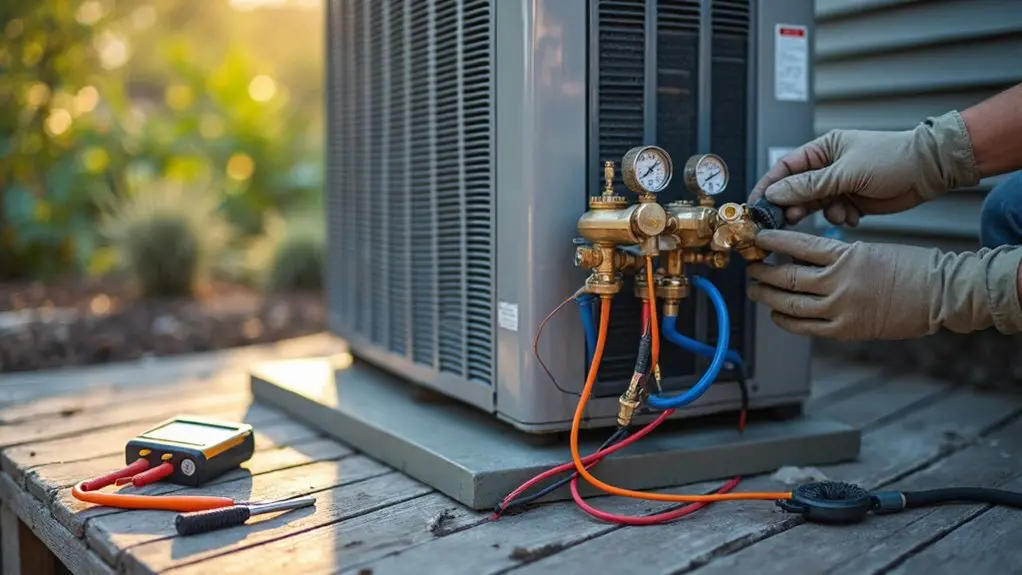
You’ll need to schedule bi-annual professional tune-ups before heating and cooling seasons to maintain your heat pump’s efficiency and warranty coverage. Between professional services, replace air filters every 1-3 months, clear debris within 18 inches of your outdoor unit monthly, and clean outdoor coils with a gentle hose setting. Professional technicians will check refrigerant levels, lubricate moving parts, inspect electrical connections, and test system controls. Understanding these thorough maintenance procedures guarantees ideal performance year-round.
Key Takeaways
- Schedule bi-annual professional tune-ups before heating and cooling seasons to maintain warranty coverage and optimal efficiency.
- Replace air filters every 1-3 months to prevent airflow restrictions and maintain ideal system performance.
- Clear debris within 18 inches of outdoor unit monthly and clean coils with gentle water spray.
- Monitor condensate drain line for blockages and pour vinegar quarterly to prevent algae buildup.
- Check thermostat regularly for accurate temperature readings and ensure proper system control adjustments.
Why Regular Heat Pump Maintenance Matters for Your Home
While heat pumps operate reliably for years with proper care, they’ll deteriorate rapidly without scheduled maintenance intervals. Regular maintenance directly impacts your heat pump’s operational efficiency and longevity. When you neglect routine servicing, you’re risking warranty voidance and accelerated system degradation that leads to costly replacements.
Professional maintenance guarantees critical components function ideally. Technicians verify refrigerant levels, clean evaporator and condenser coils, lubricate moving parts, and inspect electrical connections. These procedures prevent performance degradation and identify potential failures before they cause system breakdowns.
Your maintenance responsibilities include replacing the air filter every 2-3 months and clearing debris around the outdoor unit. These tasks maintain proper airflow and heat exchange efficiency.
Scheduling professional tune-ups twice yearly—before heating and cooling seasons—keeps your system operating at peak capacity while minimizing energy consumption and utility costs.
How Often Should You Schedule Professional Heat Pump Service
Because heat pumps operate year-round in both heating and cooling modes, you’ll need professional service twice a year to maintain excellent performance. Schedule your first maintenance appointment before the cooling season begins in spring, and your second before the heating season starts in fall.
This bi-annual professional service schedule prevents warranty voiding and guarantees optimal energy efficiency throughout each operating season. Your technician will perform critical tasks during these visits: inspecting refrigerant levels, cleaning evaporator and condenser coils, lubricating moving parts, testing system controls, and checking electrical connections.
Skipping regular professional maintenance leads to decreased efficiency, premature component failures, and costly repairs. Between professional visits, you’ll need to change air filters every 1-3 months to support system performance. This combined approach of professional service twice annually plus homeowner filter maintenance creates an all-encompassing maintenance strategy that extends your heat pump’s lifespan while maintaining peak energy efficiency and reliable operation.
DIY Heat Pump Maintenance Tasks You Can Handle Yourself
Regular maintenance between professional service appointments keeps your heat pump running efficiently and prevents minor issues from becoming major problems. You can perform several essential DIY maintenance tasks safely without specialized tools or expertise.
Replace your air filters every 2-3 months to maintain proper airflow and system proficiency. Check your outdoor unit monthly, clearing all debris within 18 inches to guarantee adequate heat exchange. Inspect and clean the outdoor coils using a garden hose on gentle setting, removing dirt and obstructions that reduce performance.
Monitor your condensate drain line for blockages that cause water backup. Pour a cup of white vinegar down the drain quarterly to avert algae buildup. Check your thermostat regularly, making certain it accurately reflects current temperature conditions and responds properly to adjustments.
This routine DIY maintenance extends your heat pump’s lifespan, reduces energy costs, and preserves optimal comfort levels throughout the year.
What Professional Technicians Check During a Seasonal Tune-Up
Professional technicians perform thorough system evaluations that go beyond basic homeowner maintenance, using specialized equipment and expertise to identify potential problems before they cause system failures. They’ll systematically inspect your heat pump’s critical components to guarantee optimal performance.
Refrigerant levels receive careful attention, as technicians measure system pressure and recharge when necessary to maintain proper cooling and heating capacity. Electrical connections undergo detailed inspection, with loose wiring tightened to prevent dangerous malfunctions or tripped breakers.
Motors and moving parts get professional lubrication to minimize friction and extend component lifespan. Technicians examine belts for proper tension and wear indicators, replacing deteriorated ones to preserve airflow efficiency.
Thermostat and system controls receive extensive testing to verify accurate temperature readings and seamless communication between your control system and heat pump. Professional technicians utilize diagnostic tools unavailable to homeowners, enabling precise calibration and early detection of developing issues that could lead to costly repairs.
Air Filter Replacement: The Most Important DIY Task
The single most impactful maintenance task you can perform between professional tune-ups involves replacing your heat pump’s air filter every 2-3 months. This simple procedure prevents system degradation and maintains ideal Air Conditioning performance.
Clogged air filters create dangerous conditions by restricting airflow, forcing your system to work harder and increasing energy consumption. When you don’t change the filter regularly, contaminants like Pet dander accumulate, reducing indoor air quality and potentially causing your system to run low on refrigerant due to ice formation from restricted airflow.
To change the filter safely, turn off your heat pump first. Locate the filter compartment, typically near the indoor unit. Remove the old filter, noting airflow direction arrows. Install the new filter with arrows pointing toward the unit. Never operate your system without a filter installed.
Regular air filters replacement protects both your investment and your family’s health while maintaining peak system efficiency.
Outdoor Unit Care and Debris Removal Guidelines
Why does your heat pump’s outdoor unit require consistent attention throughout the seasons? Environmental debris accumulates rapidly around the unit, restricting airflow and reducing system efficiency. You’ll need to maintain a clear perimeter for optimal performance.
Begin by shutting off power at the disconnect switch. Remove leaves, twigs, grass clippings, and other organic matter from around the outdoor unit. Maintain a minimum two-foot clearance on all sides. Trim vegetation that’s grown too close to the unit.
Inspect the condenser coils for dirt buildup. Use a garden hose with gentle pressure to rinse debris from the coils, spraying from inside outward. Never use a pressure washer, as it can damage delicate fins.
Check the unit’s top and remove any accumulated debris from the fan area. Around the outdoor unit’s base, guarantee proper drainage to prevent water pooling. Clear blocked drain holes if water isn’t flowing away correctly.
Signs Your Heat Pump Needs Professional Attention
While routine maintenance keeps your heat pump running smoothly, certain warning signs indicate you’ll need a certified HVAC technician’s expertise. Don’t disregard these critical indicators that your heat pump needs professional service:
- Strange noises – Grinding, squealing, or hissing noises suggest mechanical failure, refrigerant leaks, or damaged components requiring immediate professional HVAC intervention.
- Inconsistent temperatures – If your system struggles to maintain set temperatures or produces inadequate heating/cooling, internal components may be malfunctioning.
- Electrical issues – Frequent circuit breaker trips, flickering lights during startup, or burning odors indicate serious electrical problems that pose safety hazards.
- Refrigerant problems – Ice buildup on coils, reduced airflow, or warm air during cooling mode often signal refrigerant leaks or system pressure issues.
These symptoms require specialized diagnostic equipment and technical expertise beyond typical maintenance visits. When you notice these warning signs, call us immediately to prevent costly damage and confirm safe operation.
Conclusion
You’ve now armed yourself with the maintenance arsenal needed to keep your heat pump running like a well-oiled machine. Think of these tasks as your home’s insurance policy—neglecting them is like walking a tightrope without a safety net. Stay vigilant for warning signs, follow proper safety protocols, and don’t hesitate to call professionals when you’re out of your depth. Your heat pump’s longevity depends on your consistent, methodical attention to these critical maintenance steps.