
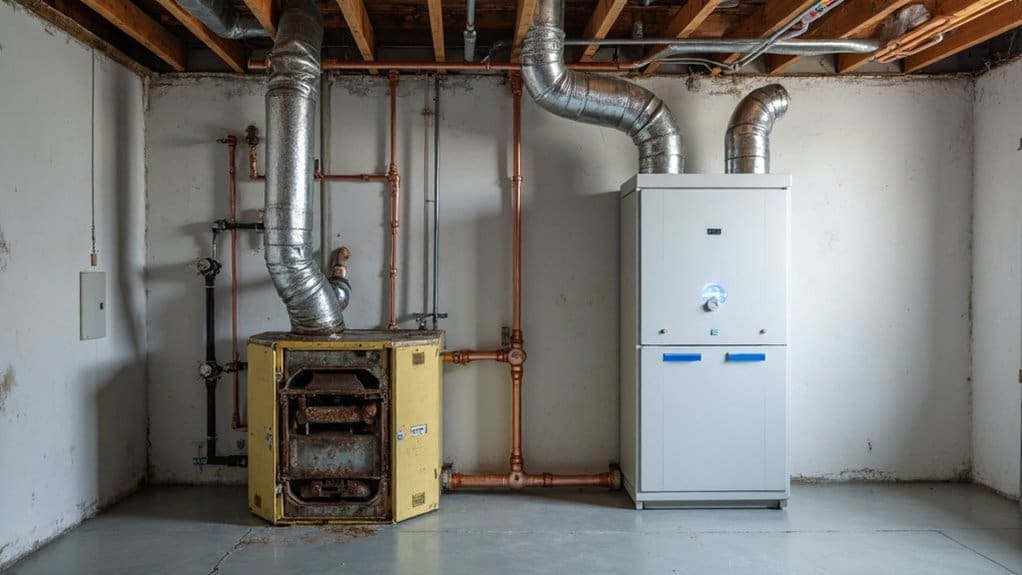
You’ll find that high-efficiency furnace replacement is generally worth the investment, offering 90% AFUE ratings compared to standard 80% models. You’ll save up to 20% on energy bills while enjoying superior comfort through variable-speed motors and two-stage heating. Though upfront costs are higher, you’ll typically recover your investment within 4-7 years through consistent savings. You’ll also benefit from available rebates, tax credits, and increased home value. The following details reveal exactly when this upgrade makes financial sense.
Key Takeaways
- High-efficiency furnaces achieve 90%+ AFUE ratings, delivering up to 20% energy savings compared to standard 80% AFUE models.
- Investment typically pays back within 4-7 years through reduced heating bills and available rebates or tax credits.
- Advanced features like variable-speed motors and two-stage heating provide superior comfort with quieter operation and precise temperature control.
- Condensing technology and secondary heat exchangers capture additional heat from exhaust gases, maximizing fuel efficiency and minimizing waste.
- Enhanced filtration systems and reduced emissions create healthier indoor air quality while supporting environmental sustainability goals.
Understanding High-Efficiency Furnace Ratings and Technology
When you’re considering a high-efficiency furnace replacement, understanding the Annual Fuel Utilization Efficiency (AFUE) rating becomes crucial for making an informed decision. The Utilization Efficiency (AFUE) rating measures how effectively your heating system converts fuel into usable heat. Standard furnaces typically achieve 80% efficiency, while a high-efficiency model reaches 90% AFUE or higher.
High-efficiency furnaces utilize condensing technology that captures additional heat from exhaust gases before they’re vented outside. This advanced HVAC technology can reduce your fuel consumption by 20% or more compared to conventional units. Modern high-efficiency furnace models feature sophisticated components like variable-speed motors and two-stage heating systems that optimize performance while maintaining consistent indoor temperatures.
These enhanced features allow your heating system to adjust output based on your home’s specific needs, providing superior comfort while maximizing energy savings throughout the heating season.
Key Differences Between Standard and High-Efficiency Furnaces
While both standard and high-efficiency furnaces serve the same fundamental purpose of heating your home, they differ considerably in their design, operation, and performance capabilities.
Standard furnaces achieve 80% AFUE ratings, meaning they convert 80% of fuel into usable heat. In contrast, a high-efficiency furnace reaches 90% AFUE or higher through advanced condensing technology and secondary heat exchangers that capture additional heat from exhaust gases.
These efficiency differences translate directly into energy savings on your gas bills. High-efficiency models operate more quietly while providing superior temperature and humidity control throughout your home.
However, upgrading requires additional considerations. You’ll need venting modifications and condensate drain installation, which increases upfront costs. Despite higher initial investment, the substantial fuel savings, combined with available tax credits and rebates, often make high-efficiency heating systems worth the expense over time, delivering long-term energy bill reductions.
Financial Benefits and Long-Term Savings Potential
Beyond the immediate comfort improvements, high-efficiency furnaces deliver substantial financial returns that make the investment increasingly attractive over time. You’ll see up to 20% reduction in energy consumption compared to standard models, directly translating to lower energy bills and substantial cost savings on your amount of heating expenses.
While the upfront cost represents a larger initial investment, available rebates and tax credits help offset this expense. Your return on investment typically occurs within 4-7 years through consistent cost savings over time. High efficiency models reduce your monthly heating costs considerably, creating compounding savings throughout the system’s lifespan.
You’ll also boost your home’s resale value, as energy-conscious buyers prioritize properties with reduced utility costs. If you’re planning long-term homeownership, these significant savings multiply substantially. The combination of immediate energy bill reductions, available incentives, and increased property value makes high-efficiency furnaces a financially sound decision beyond their superior performance capabilities.
Enhanced Comfort and Indoor Air Quality Features
The financial advantages of high-efficiency furnaces represent just one aspect of their superior value proposition. Your high-efficiency unit delivers exceptional comfort through advanced heating and cooling technologies that standard heating systems can’t match. These efficient models feature variable-speed motors and two-stage heating, providing precise temperature control throughout your home.
Your indoor air quality receives significant upgrades when furnaces come equipped with HEPA filtration systems. These filters capture 99.97% of airborne particles as small as 0.3 microns, creating healthier living spaces. The heat exchanger in your high-efficiency furnace utilizes condensing technology, safely reusing exhaust heat while maintaining ideal comfort levels.
Key comfort enhancements include:
- Whisper-quiet operation through improved insulation and variable-speed technology
- Integrated humidification systems that maintain optimal moisture levels year-round
- Consistent temperature distribution eliminating hot and cold spots throughout your home
Unlike geothermal heating alternatives, high-efficiency furnaces provide immediate comfort improvements while transforming your indoor environment into a healthier, more comfortable sanctuary.
Environmental Impact and Energy Conservation
As climate concerns intensify globally, your choice to install a high-efficiency furnace creates measurable environmental benefits that extend far beyond your home’s walls. These advanced furnaces produce fewer greenhouse gas emissions while delivering superior heat to combat cold weather. Your investment in 90-98% AFUE efficiency cuts fuel usage by up to 20% compared to standard 80% AFUE models, translating to less environmental impact and reduced energy cost.
The secondary heat exchanger technology maximizes every fuel unit, extracting more usable heat while minimizing waste. This means your home requires less fuel to maintain comfortable temperatures throughout cold seasons. Reduced carbon footprints result from this enhanced efficiency, supporting sustainable living practices. The installation of high-efficiency furnaces represents an environmentally responsible investment that combines personal comfort with ecological stewardship, proving that upgrading your heating system benefits both your household and the planet’s future.
Available Tax Credits, Rebates, and Financial Incentives
Financial incentives make high-efficiency furnace upgrades more affordable than ever, with federal tax credits offering up to 30% back on your investment. While high-efficiency furnaces are more expensive upfront, these savings help offset costs and make it worth spending the extra money. Your high-efficiency furnace may qualify for multiple incentives simultaneously.
The Inflation Reduction Act provides an Energy Efficient Home Improvement Tax Credit up to $600 for qualifying High-Efficiency Gas Furnace installations. Many utility companies offer substantial rebates for ENERGY STAR-certified models, recognizing that using less fuel and less natural gas benefits everyone through reduced demand.
Here’s how to maximize your savings:
- Federal tax credits – Claim up to 30% of installation costs on Department of Energy approved systems
- Utility rebates – Stack company incentives with federal credits for maximum benefit
- Local programs – Research municipal tax breaks and additional rebate opportunities
These combined incentives help you make an informed decision while enjoying lower utility bills long-term.
When High-Efficiency Furnaces May Not Be the Right Choice
While high-efficiency furnaces offer impressive long-term savings, they’re not always the wise choice for every homeowner’s situation. If you’re planning to move within a few years, the higher upfront costs won’t justify the investment given your expected tenure. The payback period extends well beyond what makes financial sense for short-term homeowners.
Your home’s existing infrastructure matters greatly. Without proper insulation or if you have substantial air leaks, even the most efficient furnace won’t deliver meaningful energy savings. You’ll essentially waste money on advanced technology that can’t perform ideally in a compromised environment.
Older ductwork systems can create compatibility issues, requiring expensive modifications that increase your initial outlay. If minimizing upfront expenses is your priority rather than pursuing long-term energy savings, a standard-efficiency furnace might better suit your immediate needs and budget constraints.
Professional Installation and System Compatibility Considerations
Even if you’ve determined a high-efficiency furnace suits your situation, improper installation can sabotage your investment’s performance and longevity. Experienced HVAC professionals provide installation services that guarantee your new heating units function optimally and deliver promised energy savings.
Your HVAC contractor must evaluate system compatibility with existing ductwork and infrastructure. High-efficiency furnaces often require modifications including:
- Venting and condensate drain upgrades – New venting systems and condensate lines accommodate sealed combustion technology
- Smart home integration – Ensuring units are compatible with smart thermostats maximizes efficiency controls
- Proper installation protocols – Following manufacturer specifications prevents performance issues and warranty voiding
Consulting with qualified professionals gives you peace of mind that your investment will perform as expected. They’ll assess whether your home’s current HVAC system can support a high-efficiency upgrade without costly modifications. Don’t let poor installation limit your furnace’s potential – professional expertise safeguards both your comfort and financial investment.
Frequently Asked Questions
Is a High-Efficiency Furnace Worth the Extra Cost?
You’ll find high-efficiency furnaces worth it through energy savings potential, rebate availability, and comfort improvement. Despite installation complexity and maintenance requirements, the payback period justifies long-term cost analysis, especially considering eco-friendly benefits.
What Are the Disadvantages of High-Efficiency Furnaces?
You’ll face a steeper financial mountain with higher purchase prices, increased installation complexity, and potential maintenance challenges. Cold climate performance issues, reduced heating capacity, venting system requirements, and software control issues can create unexpected hurdles.
What Is the Average Lifespan of a High-Efficiency Furnace?
You’ll get 20-30 years from your high-efficiency furnace with proper annual maintenance requirements. Professional installation guidance guarantees ideal performance, while long term cost analysis shows you’ll maximize energy savings projections throughout its extended lifespan.
Is It Worth Fixing a 20 Year Old Furnace?
Most 20-year-old furnaces waste 30% more energy than modern models. You shouldn’t fix yours—furnace repair costs plus ongoing furnace operating expenses exceed furnace replacement considerations. New units offer better furnace energy efficiency ratings and furnace financing options.
Conclusion
You’ll need to weigh your specific circumstances carefully. Consider Sarah, a Chicago homeowner who replaced her 20-year-old furnace with a 95% AFUE model. Despite the $4,500 upfront cost, she’s saving $800 annually on heating bills and received $1,200 in rebates. Her payback period? Just five years. If you’re planning to stay in your home long-term and your current furnace is aging, a high-efficiency replacement often proves financially sound.