
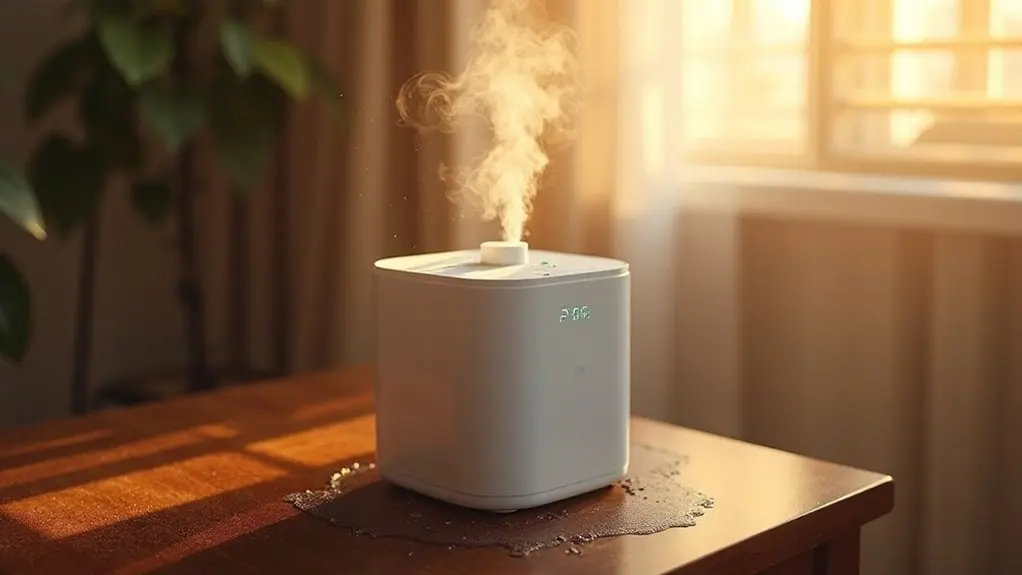
When your humidifier stops producing mist, start by checking if you’re using distilled water and ensuring the tank’s properly filled and secured. Next, inspect the transducer for mineral deposits or damage, then verify all electrical connections are working. Clean any buildup around the float sensor and throughout the system using vinegar or manufacturer-recommended solutions. For older units, compare repair costs against replacement prices since parts availability becomes limited. Understanding these troubleshooting steps will help you determine the best solution for your specific situation.
Key Takeaways
- Check if the water tank is properly filled with distilled water and securely installed in the unit.
- Clean mineral deposits from the transducer using a soft brush and distilled water to restore functionality.
- Verify the power connection is secure and test the outlet with another device to confirm electricity flow.
- Reset the float sensor by lifting and lowering it several times to ensure smooth movement.
- Consider replacement over repair for older units due to limited parts availability and compatibility issues.
Check Your Water Tank and Quality
When your humidifier stops producing mist, the first thing you’ll want to examine is your water tank and the quality of water you’re using. Guarantee the tank’s properly filled and securely installed in your humidifier.
The type of water matters greatly. Experts recommend using distilled or demineralized water instead of tap water. Hard water creates mineral buildup that clogs your humidifier’s components, preventing mist production. This situation also causes white dust to circulate throughout your room.
If you’ve been using tap water, mineral deposits have likely accumulated in your tank and internal parts. You’ll need thorough cleaning to remove these deposits and any bacterial growth. Regular maintenance averts this repair scenario entirely.
While distilled water costs more money upfront, it saves you from frequent deep-cleaning sessions. You can find detailed cleaning information online, but switching to distilled water remains the most effective long-term solution for consistent mist production.
Inspect the Transducer for Damage or Buildup
The transducer serves as your humidifier’s heart, creating the ultrasonic vibrations that transform water into fine mist. When your humidifier stops producing mist, the transducer is often the culprit. This critical component can suffer from mineral deposits and damage that prevent proper operation.
Here’s how to inspect your transducer:
- Locate the transducer – Usually found at the bottom of the water tank as a small, circular metal disc
- Check for visible damage – Look for cracks, chips, or signs of wear on the surface
- Examine for buildup – White or chalky mineral deposits indicate hard water accumulation
- Clean gently – Use a soft-bristled brush with distilled water to remove deposits without scratching
- Test vibration – When powered on, you should feel slight vibrations from a functioning transducer
If cleaning doesn’t restore function or damage is severe, you’ll need to replace the transducer with a compatible part to restore your humidifier’s mist production.
Verify Power Supply and Electrical Connections
Before examining internal components like the transducer, you’ll want to confirm your humidifier is receiving adequate power. Start by checking that the power cord is securely plugged into a functional electrical outlet. Test the outlet with another device to verify it’s working properly.
Next, inspect your humidifier’s fuse or circuit breaker. If either has blown or tripped, you’ll need to replace the fuse or reset the circuit breaker. These safety components can prevent power flow when they detect electrical issues.
Don’t forget to check if your humidifier has a control lock feature. When activated, this setting prevents operation even when electrical connections are sound. Simply turn off the control lock to restore normal function.
If you’ve verified all electrical connections and the problem persists, contact a professional repair service. They can provide proper diagnosis and repair of complex electrical issues that require specialized expertise.
Reset the Float Sensor
Many humidifiers feature a float sensor that automatically shuts off mist production when water levels drop too low. Sometimes this sensor gets stuck or malfunctions, preventing your unit from producing mist even with adequate water.
To reset your float sensor:
- Unplug the humidifier and remove the water tank completely
- Locate the small plastic float inside the base – it should move freely up and down
- Gently lift and lower the float several times to guarantee smooth movement
- Clean around the float mechanism, removing any mineral buildup from hard water deposits
- Reassemble everything and plug the unit back in
Using distilled water greatly improve sensor longevity and reduces mineral deposits. If your display shows error codes or the float remains stuck after cleaning, you might need home repair assistance. Many HVAC services offer expert tips for persistent issues and are ready to help with complex humidifier problems.
Clean Clogged Components and Filters
Mineral buildup frequently causes humidifiers to lose their mist-producing power, making regular cleaning your most effective solution. You’ll need to clean the transducer, water tank, and other components to remove deposits that clog the system and prevent mist production.
Start by unplugging your humidifier and emptying the water tank completely. Use white vinegar or a manufacturer-recommended cleaning solution to dissolve mineral buildup on the transducer and tank surfaces. Scrub gently with a soft brush to avoid damage.
Don’t forget your filters – replace any damaged or worn-out filters to guarantee proper airflow and water filtration. Clogged filters restrict performance considerably.
Always consult your manufacturer’s instructions for model-specific cleaning procedures, as requirements vary between units. Use distilled or demineralized water moving forward to minimize future mineral deposits.
Regular maintenance prevents gradual decline in mist output and protects your humidifier from potential damage, assuring consistent performance.
Address Mineral Deposits From Hard Water
Hard water wreaks havoc on humidifiers by leaving behind calcium and magnesium deposits that gradually choke off mist production. These mineral deposits accumulate on critical components, blocking water flow and preventing proper operation.
Combat mineral buildup with these strategies:
- Switch to distilled water – Eliminates minerals that cause deposits, extending your humidifier’s lifespan
- Use purified water – Filtered water reduces mineral content compared to tap water
- Perform regular cleaning – Weekly maintenance prevents deposits from hardening and becoming difficult to remove
- Focus on ultrasonic humidifiers – These units are especially vulnerable since mineral deposits coat the vibrating transducer
- Schedule deep cleaning – Monthly descaling removes stubborn mineral buildup using vinegar solutions
Neglecting mineral deposits destroys your humidifier’s efficiency over time. The transducer in ultrasonic models can’t vibrate properly when coated with minerals, while evaporative units suffer from clogged wicks and filters. Regular cleaning and using distilled water prevents costly repairs.
Evaluate Age-Related Wear and Component Failure
Time takes its toll on every humidifier, and your unit’s age directly impacts its ability to produce consistent mist. If you’re dealing with a 3+ year old model, you’re likely facing transducer wear that considerably reduces mist production. Older units become magnets for electrical issues and mechanical malfunctions that compound over time.
Regular water exposure gradually degrades internal components, making repair increasingly necessary. However, finding compatible replacement parts for aging models often proves challenging, especially for discontinued units. The transducer, your humidifier’s heart, becomes particularly susceptible to failure as years pass.
Before investing in costly repairs, evaluate the cost-effectiveness of fixing versus buying new. A replacement unit might offer better long-term value than repeatedly repairing an aging system. Contact the manufacturer or consult an expert to assess whether your humidifier’s worth salvaging. Sometimes, replacement trumps repair for older units experiencing persistent mist production problems.
Consider Replacement Vs Professional Repair Options
Eventually, you’ll face the pivotal decision between professional repair and complete replacement when your humidifier stops producing mist. Several factors determine which option proves most cost-effective for your situation.
Consider these key elements when making your choice:
- Age and model – Older units often have limited replacement part availability, making replacement more practical
- Transducer costs – Compare user-replaceable transducers against new unit prices to assess value
- Compatibility issues – Verify replacement parts match your specific model before purchasing
- Difficulty level – Evaluate whether you can handle the repair or need professional assistance
- Expert consultation – A verified expert can help determine if your unit can be properly diagnosed and repaired
Professional repair becomes worthwhile when parts are readily available and the unit’s relatively new. However, replacement often proves more cost-effective for older models with worn transducers, especially when compatibility becomes questionable.
Conclusion
You’ve now got the tools to diagnose your humidifier’s mist problems, from water quality issues to worn components. Don’t ignore these fixes—poor indoor humidity affects more than comfort. Studies show that maintaining proper humidity levels can reduce respiratory infections by up to 43%. Whether you’re cleaning mineral deposits or considering replacement, you’re investing in your family’s health. Take action today, because the air you breathe shouldn’t leave you struggling for moisture.