
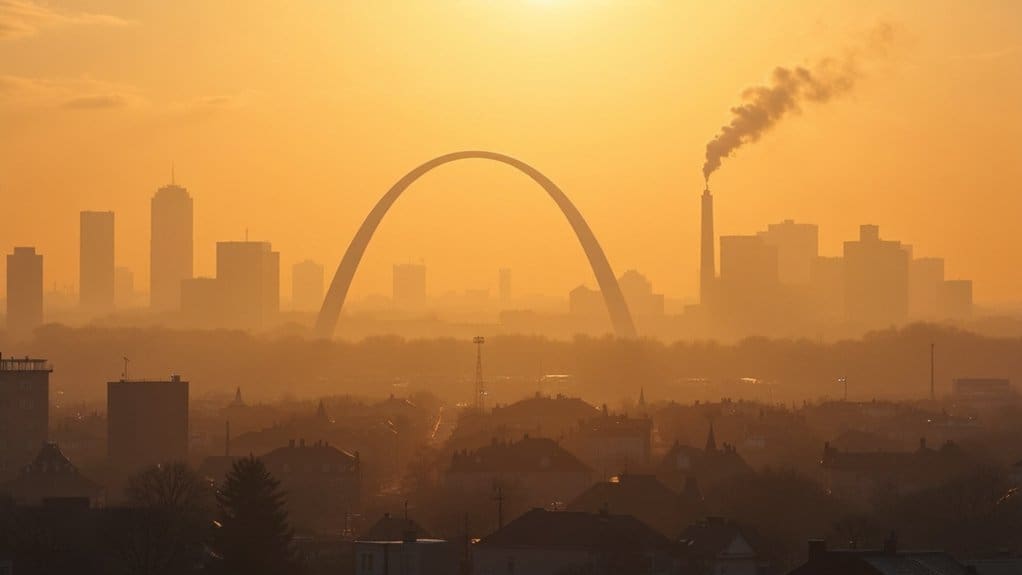
You’re breathing polluted air in St. Louis whether you realize it or not, as the metro area ranks among the nation’s worst for ozone pollution with an F grade and sees increasingly frequent unhealthy air days that seep directly into your home. Particle pollution exceeds federal standards, while seasonal challenges from industrial reactions and winter fuel burning create year-round indoor contamination. Your HVAC system with proper filtration becomes your frontline defense against these persistent health threats affecting your daily life.
Key Takeaways
- St. Louis ranks 21st worst nationally for ozone pollution with an F grade and increasing unhealthy air days.
- Only 19 of 114 Missouri counties have air quality monitoring stations, leaving residents unaware of pollution exposure risks.
- Black and low-income communities face disproportionately higher health impacts, with Black children visiting emergency rooms 10x more for asthma.
- Seasonal pollution varies from ozone formation in warm weather to increased particle pollution from winter fuel burning.
- HVAC systems with HEPA filters and air purifiers provide essential frontline defense against persistent indoor air contamination.
St. Louis Air Quality Crisis: Ozone and Particle Pollution Rankings
The St. Louis metro area’s air quality crisis demands your immediate attention. You’re breathing air that ranks 21st worst nationally for ozone pollution, earning a failing F grade. Your community’s unhealthy air days have increased dramatically from 6 to 10.5 annually, putting your respiratory health at serious risk.
While particle pollution shows slightly better rankings at 88th worst with a D grade, you’re still exposed to year-round average levels exceeding federal standards. If you live in St. Louis County, Missouri, you’re facing the metro area’s worst particle pollution concentrations.
These statistics reveal environmental justice concerns affecting your daily life. Without proper air filtration systems, you can’t escape this contaminated outdoor air infiltrating your home. Indoor air quality becomes your last line of defense against harmful pollutants. Installing effective air filtration isn’t luxury—it’s essential for accessing clean air and protecting your family’s long-term health.
Health Disparities and Environmental Justice in Missouri Communities
Air pollution doesn’t affect all St. Louis residents equally. If you’re Black or live in low-income communities, you’ll face disproportionately higher health impacts from poor air quality compared to white and higher-income neighbors. Environmental justice concerns are stark—Black children are 10 times more likely than white children to visit emergency rooms for asthma.
You’re more likely to breathe harmful particulate matter if you live near highways, interstates, and industrial facilities, where people of color disproportionately reside. This creates significant health disparities across the city’s neighborhoods.
Limited neighborhood-level air quality monitoring makes it harder for affected communities to advocate for policy changes. However, faith-based organizations like Metropolitan Congregations United are partnering with researchers to collect localized pollution data and raise awareness.
Given these environmental justice issues, improving your indoor air quality through filtration systems becomes even more critical if you’re in vulnerable communities facing higher outdoor pollution exposure.
The Gap in Air Quality Monitoring Across Missouri Counties
Surprisingly, only 19 of Missouri’s 114 counties have air quality monitoring stations, leaving vast swaths of the state—particularly rural communities—without official pollution data. This massive gap means you’re likely living in an area where air quality data simply doesn’t exist, making it impossible to understand what you’re breathing daily.
Rural communities across Missouri face significant pollution from agriculture, mining, and industrial operations, yet they can’t access the essential data needed to advocate for change. Without neighborhood-level data, vulnerable communities remain unaware of their exposure risks and can’t push for necessary improvements.
This monitoring deficit severely limits Missouri’s ability to assess pollution’s true impact and prioritize air quality improvement efforts. When official data doesn’t exist in your area, you can’t rely on government monitoring to protect your health. That’s why investing in air filtration systems becomes crucial—providing the protection that missing in-depth data and inadequate monitoring can’t guarantee.
Indoor Air Pollution Sources and Seasonal Challenges
While Missouri’s monitoring gaps leave you guessing about outdoor air quality, indoor air pollution sources pose their own serious challenges that shift dramatically with the seasons. Outdoor pollutants from industry, vehicles, and seasonal factors like pollen infiltrate your home through windows, doors, and HVAC systems, compromising your indoor environment.
Spring and summer bring particularly harsh conditions as warm weather causes industrial pollutants to react with sunlight, creating dangerous ozone levels. However, winter proves worst for overall air quality when increased fuel burning elevates particle pollution both indoors and outdoors.
You’ll face year-round challenges requiring daily Air Quality Index monitoring. Combat these issues by eliminating gas-powered appliances, ensuring proper ventilation, and maintaining your HVAC systems regularly. Since outdoor pollution varies dramatically throughout the year on the 1-500 scale, investing in home air filtration becomes essential for protecting your family’s health against St. Louis’s persistent indoor air pollution challenges.
How HVAC Systems and Air Filtration Technology Combat Poor Air Quality
Your HVAC system serves as the frontline defense against St. Louis’s challenging air quality conditions. Advanced air filtration technology integrated into your HVAC transforms your home into a sanctuary from harmful pollutants, allergens, and particulate matter.
HEPA filters and ultraviolet light air purifiers work together, trapping and destroying airborne contaminants before they circulate through your living spaces. These systems effectively capture microscopic particles that standard filters miss, substantially improving your indoor air quality.
Regular HVAC maintenance, including timely filter changes, guarantees consistent air cleaning and optimal ventilation performance. Neglecting this maintenance compromises your system’s effectiveness against pollutants.
Air scrubbers and dehumidifiers complement your HVAC by reducing humidity levels and eliminating airborne pathogens. This combination creates a thorough approach to air purification.
Upgrading to an energy recovery ventilator enhances air circulation while controlling temperature and humidity. ERVs recover energy from exhaust air, making your system more efficient while maintaining superior indoor air quality year-round.
Community-Driven Solutions and Faith-Based Environmental Action
Individual air filtration systems work best when combined with broader community efforts to tackle St. Louis’s environmental challenges. You’ve witnessed remarkable faith-based action through Metropolitan Congregations United’s partnership with Washington University researchers, where churches and community centers host air pollution monitoring stations throughout the region.
These congregations put their faith into practice by addressing environmental justice head-on, recognizing air quality disparities that create disproportionate impact on Black and low-income residents. Their grassroots solutions nearly tripled regional monitoring capabilities, empowering you and your neighbors to advocate for cleaner air.
Through the PurpleAir network, churches continue tracking community health data while integrating environmental concerns into their creation care ministries. This community engagement demonstrates how faith-based organizations inspire broader participation in combating environmental racism. You benefit from these expanded monitoring networks that provide localized data, helping identify pollution hotspots and supporting advocacy efforts for systemic change beyond individual air filtration solutions.
Frequently Asked Questions
What Are the Average Costs of Installing Whole-Home Air Filtration Systems?
You’ll spend $1,500-$4,500 for professional installation costs of whole-home systems, depending on average home size requirements. Consider energy efficiency considerations, system lifespan and warranties, plus long term operating expenses when comparing options.
Which Specific Air Filter Brands Perform Best in St. Louis Conditions?
Traversing filter brands is like choosing armor for your home. You’ll find Honeywell’s HEPA filter effectiveness and Carrier’s MERV rating significance excel, while Aprilaire’s pleated media filter types and Lennox’s activated carbon filter benefits dominate St. Louis’s challenging air conditions.
How Often Should Air Filters Be Replaced in High-Pollution Areas?
You’ll need frequent filter replacement in high-pollution areas—typically every 1-2 months instead of quarterly. Monitor filter replacement indicators, establish strict maintenance schedules, and consider filter upgrade considerations for better clogging prevention and cost-benefit analysis.
Do Portable Air Purifiers Work Effectively in Small Apartments?
You’ll find portable air purifiers highly effective in small apartments, especially models with HEPA filter types and carbon filter options. Look for space saving designs featuring quiet operation modes, energy efficiency ratings, and user friendly controls.
Are There Government Rebates Available for Purchasing Air Filtration Equipment?
While financial circumstances might present challenges, you’ll find tax incentives, utility company rebates, and low income household subsidies available. Energy efficiency credits, government grant opportunities, and community organization funding can help offset air filtration costs substantially.
Conclusion
You’re living in a city where air quality fails federal standards 35+ days annually, putting your family’s health at constant risk. Missouri’s environmental challenges won’t solve themselves – you need to take action now. Installing a quality HVAC air filtration system isn’t just an upgrade; it’s essential protection for your lungs and loved ones. Don’t wait for cleaner outdoor air that may never come. You’ve got the power to breathe easier indoors today.