
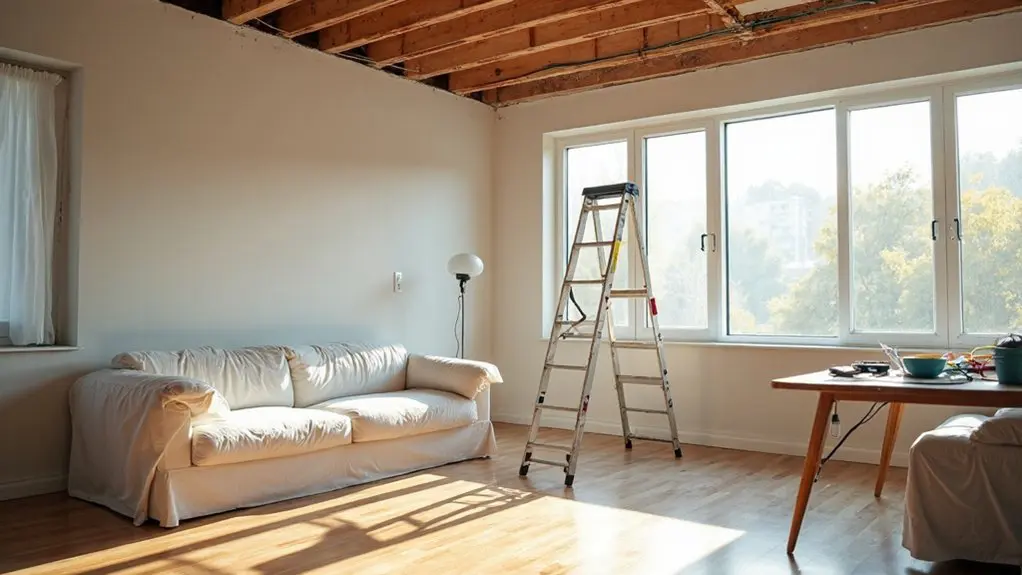
Before your air conditioning installation, you’ll need to assess your home’s cooling demands and schedule a professional evaluation to determine proper system sizing. Clear access points around your furnace, electrical panel, and outdoor condenser area by removing furniture and obstacles. Inspect your ductwork for leaks and seal any gaps with mastic or foil tape. Verify your electrical system can handle the new unit’s power requirements. Following these preparation steps will help guarantee a smoother installation process and discover additional ways to optimize your new system’s performance.
Key Takeaways
- Schedule professional evaluation to assess cooling needs, measure square footage, and perform load calculations for proper sizing.
- Clear furniture and obstacles from work areas including furnace, attic, outdoor condenser, and electrical panel locations.
- Inspect and seal ductwork gaps using mastic sealant, then clean thoroughly to remove dust and debris.
- Ensure unobstructed pathways throughout home for safe equipment transport and create designated quiet workspace areas.
- Keep pets and children away from installation zones while preparing for system demonstration and maintenance review.
Assess Your Home’s Cooling Requirements and System Options
Before you can select the right air conditioning system, you’ll need to thoroughly evaluate your home’s specific cooling demands and explore the available options. Start by assessing your home’s size and room count, as these factors directly influence the cooling capacity requirements. Your climate zone also plays a pivotal role in determining which system type will perform most efficiently.
Consider three primary system options: central air conditioning works well for larger homes with existing ductwork, while ductless mini-splits offer flexibility for homes without ducts or specific room cooling needs. Heat pumps provide both heating and cooling, making them ideal for moderate climates.
Understanding the load calculation process is essential, as HVAC technicians use this method to determine proper system sizing. This calculation considers factors like insulation, window placement, and local weather patterns to guarantee your new system delivers peak performance without wasting energy.
Schedule a Professional Pre-Installation Evaluation
Why should you invest in a professional pre-installation evaluation when you’ve already assessed your cooling needs? A qualified HVAC technician brings expertise that safeguards your new air conditioning system will function optimally in your specific home environment.
During the evaluation, the technician will measure your home’s square footage and analyze existing ductwork and insulation. They’ll examine your electrical system to confirm it’s compatible with your new AC unit. Most importantly, they’ll perform precise load calculations that determine the appropriate system size for your home, considering factors like climate, room count, and energy efficiency requirements.
The technician will also discuss your preferences regarding features, efficiency levels, and budget constraints. This thorough evaluation helps you select the best air conditioning system for your needs while identifying any potential installation challenges beforehand. This professional assessment guarantees a smooth installation process and maximizes your new system’s performance and energy savings.
Clear Access Points and Work Areas for Technicians
Once you’ve scheduled your professional evaluation, you’ll need to prepare your home by clearing access points and work areas for the installation team. Technicians require unrestricted access to several key areas: your furnace, air handler, attic, outdoor condenser location, and main electrical panel.
Remove furniture, decorations, boxes, and storage bins from these critical zones to give installers easy access. Don’t forget to move any vehicles that might block the outdoor installation area. Creating clear pathways throughout your home enables technicians to transport equipment safely and efficiently.
This preparation offers multiple benefits. First, it allows the installation team to work more rapidly, potentially reducing labor costs. Second, clearing work areas drastically lowers the risk of property damage to your belongings during the installation process. Most importantly, providing unobstructed access creates a safer working environment, facilitating your air conditioning installation to proceed smoothly and professionally.
Inspect and Prepare Your Ductwork System
Your home’s ductwork system forms the circulatory network that’ll distribute conditioned air throughout every room, making its condition critical to your new air conditioning system’s performance. Start by inspecting your ductwork for gaps, cracks, or damaged sections that compromise airflow and efficiency.
Seal any discovered leaks using mastic sealant or foil-backed tape to minimize air loss and enhance system performance. These materials create lasting seals that prevent conditioned air from escaping into unconditioned spaces.
Next, clean your ductwork thoroughly, removing dust, debris, and obstructions that reduce airflow and degrade air quality. Poor ductwork conditions force your new system to work harder, increasing energy costs.
Consider whether you need to upgrade or replace outdated ductwork entirely. Older systems may not support modern air conditioning equipment’s efficiency needs.
Work with an HVAC professional to evaluate your ductwork comprehensively. They’ll recommend necessary improvements to guarantee your new air conditioning system operates at ideal efficiency from day one.
Verify Electrical Capacity and Upgrade if Needed
Modern air conditioning systems demand substantial electrical power, often exceeding what older homes can safely provide through their existing electrical infrastructure. Your HVAC technician will evaluate your home’s electrical capacity to determine if upgrades are necessary before installation.
During this assessment, the technician examines your electrical panel and circuits to safeguard they can handle the new system’s power requirements. Older homes frequently need electrical improvements since their electrical setup wasn’t designed for today’s high-efficiency units’ power demand.
Key electrical considerations include:
- Panel capacity – Verifying your electrical panel has adequate amperage for the AC unit
- Circuit availability – Confirming dedicated circuits exist for the new equipment
- Wiring condition – Checking that existing wiring meets current safety standards
If your electrical system requires upgrades, you’ll need to coordinate with a licensed electrician before AC installation. These electrical upgrades guarantee safe, reliable operation and prevent potential hazards from overloaded circuits.
Plan for Installation Day Logistics and Post-Installation Process
How can you guarantee your air conditioning installation proceeds smoothly and efficiently? Proper planning for installation day logistics safeguards minimal disruption and maximum results.
Your installation team will arrive early morning and will likely take several hours to complete the work. Clear pathways to installation areas beforehand, removing furniture, decorations, and obstacles. Keep pets and children away from the work zone for their safety and to allow technicians uninterrupted access. Designate a quiet space away from the work area where family members can remain comfortable.
Understand the Post-Installation procedures before work begins. Once installation is complete, your technician will demonstrate system operation and maintenance requirements. Pay attention when they test your system for the first time, noting any unusual sounds or behaviors. The installation process includes a thorough walkthrough of controls, filters, and warranty information. Don’t hesitate to ask questions about operation, maintenance schedules, or troubleshooting basics.
Conclusion
You’ve tackled the groundwork, and now you’re ready for installation day. Your thorough preparation will make the difference between a chaotic experience and a seamless transformation. When those technicians arrive, they’ll move through your home like a well-oiled machine, thanks to your cleared pathways and upgraded electrical system. You’ve set the stage for cool comfort that’ll last for years. Soon, you’ll be enjoying perfectly conditioned air in your prepared space.