
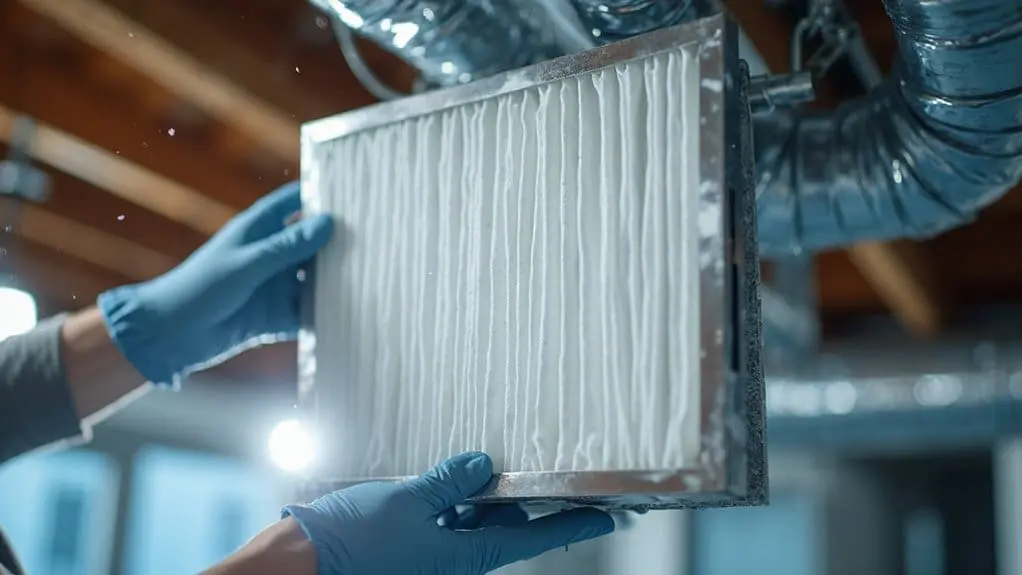
You’ll need to understand five core air filtration technologies—HEPA filters, UV light systems, activated carbon filters, ionic systems, and combination units—to achieve ideal indoor air quality. Professional installation requires technical assessment of your HVAC’s airflow capacity, ductwork dimensions, and electrical specifications for seamless integration. Regular maintenance involves filter replacement every 3-6 months, ductwork inspection, and professional servicing to maintain 99.97% particle removal efficiency. The thorough analysis below covers system selection, installation requirements, and performance optimization strategies.
Key Takeaways
- Air filtration systems include HEPA filters, UV light systems, activated carbon filters, and ionic systems for comprehensive air cleaning.
- Professional installation requires technical assessments, airflow measurements, and proper integration with existing HVAC systems by certified technicians.
- Benefits include capturing airborne contaminants, reducing allergies, improving HVAC efficiency, and extending system lifespan while providing fresher air.
- Regular maintenance involves filter replacement every 3-6 months, ductwork inspections, and professional HVAC servicing to prevent efficiency losses.
- System selection depends on home size, HVAC configuration, air quality levels, and balancing filtration efficiency with energy consumption.
Understanding Different Types of Air Filtration Systems
Modern air filtration systems employ distinct mechanisms to target specific contaminants in your indoor environment. Your HVAC system can integrate multiple air purification system technologies for extensive coverage. High-Efficiency Particulate Air (HEPA) filters capture 99.97% of particles measuring 0.3 microns, effectively removing dust, pollen, and pet dander from circulating air. UV light systems destroy bacteria, viruses, and mold spores through germicidal irradiation, providing biological contaminant control. Activated carbon filters excel at eliminating odors and gases by adsorbing volatile organic compounds onto their porous surface. Ionic air filtration systems release charged particles that bind to airborne contaminants, causing them to precipitate from the air. Your home air filtration systems should combine these technologies based on your specific indoor air quality requirements and dominant pollutant sources.
Key Benefits of Installing Air Filtration Systems in Your Home
Installing air filtration systems in your home delivers measurable improvements to your indoor environment and overall health outcomes. These systems effectively capture airborne contaminants including dust, pollen, and pet dander, directly enhancing your home’s air quality. You’ll experience reduced allergy symptoms and respiratory issues as air filters and air purifiers eliminate harmful particles from circulation.
Your HVAC systems benefit considerably through improved energy efficiency, as clean air filters prevent debris accumulation that forces equipment to work harder. This optimization extends system lifespan while reducing operational costs. Enhanced indoor air quality creates fresher, cleaner-smelling air throughout your living spaces.
For households with respiratory sensitivities, air filtration provides essential protection and peace of mind. Regular maintenance guarantees consistent performance, making these systems invaluable investments in your family’s health and comfort.
Professional Installation Process and System Requirements
Professional air filtration installation requires specific technical assessments and system compatibility evaluations to confirm effective performance. You’ll need certified technicians who understand your heating and cooling system’s specifications before beginning the installation process. The professional service starts with measuring airflow capacity, ductwork dimensions, and existing HVAC equipment compatibility.
Your AC installation must meet precise system requirements including proper voltage, amperage ratings, and mounting specifications. The technician will integrate filtration components with your air conditioning system while preserving manufacturer warranties. Critical measurements include filter housing dimensions, static pressure calculations, and CFM ratings that correspond with your HVAC system’s capacity.
Once installed, the system continues operating seamlessly with your existing equipment. Regular calibration and filter replacement schedules maintain optimal performance throughout the system’s operational lifecycle, maximizing your investment’s effectiveness.
Essential Maintenance Practices for Optimal Performance
Consistent maintenance schedules determine your air filtration system’s operational efficiency and longevity. Essential maintenance protocols guarantee efficient operation through systematic approaches that protect your investment and indoor air quality.
Regular cleaning and filter replacement every 3-6 months prevents system degradation. Your regular furnace maintenance routine should include thorough assessments of all HVAC system components. Professional inspections verify that ductwork integrity and seals remain intact, preventing efficiency losses.
Critical maintenance actions include:
- Filter replacement – Clogged filters force your system to work harder, increasing energy costs
- Ductwork inspection – Leaky ducts waste up to 30% of conditioned air
- Seal verification – Compromised seals reduce system performance dramatically
- Professional servicing – Qualified technicians identify problems before costly failures occur
Qualified technicians provide meticulous maintenance services that optimize your air filtration system’s peak performance capabilities.
Choosing the Right Air Filtration System for Your Needs
The selection of an appropriate air filtration system requires precise analysis of your home’s specific parameters and performance requirements. You’ll need to evaluate square footage, existing HVAC configuration, and current indoor air quality levels to determine ideal system specifications. High-efficiency particulate air (HEPA) filters deliver superior particle capture rates for allergen control, while activated carbon systems target odor elimination and VOC reduction.
Air filtration system selection involves balancing air filtration system efficiency against energy consumption and noise output. Consider air filtration system installation complexity within your existing infrastructure and factor in air filtration system maintenance requirements for continued performance. Professional assessment guarantees your chosen system maximizes air filtration system benefits while integrating seamlessly with current HVAC operations. This systematic approach optimizes your home’s air quality through precise system matching.
Conclusion
You’ve navigated the technical landscape of air filtration systems—now it’s time to breathe life into your home’s air quality. Your data-driven approach to system selection, coupled with precise installation protocols and systematic maintenance schedules, will optimize filtration efficiency by up to 99.97% for HEPA-grade units. You’ll maintain peak performance through scheduled filter replacements, pressure differential monitoring, and airflow calibration. Your investment in proper filtration infrastructure delivers measurable improvements in indoor air quality metrics and long-term system reliability.