
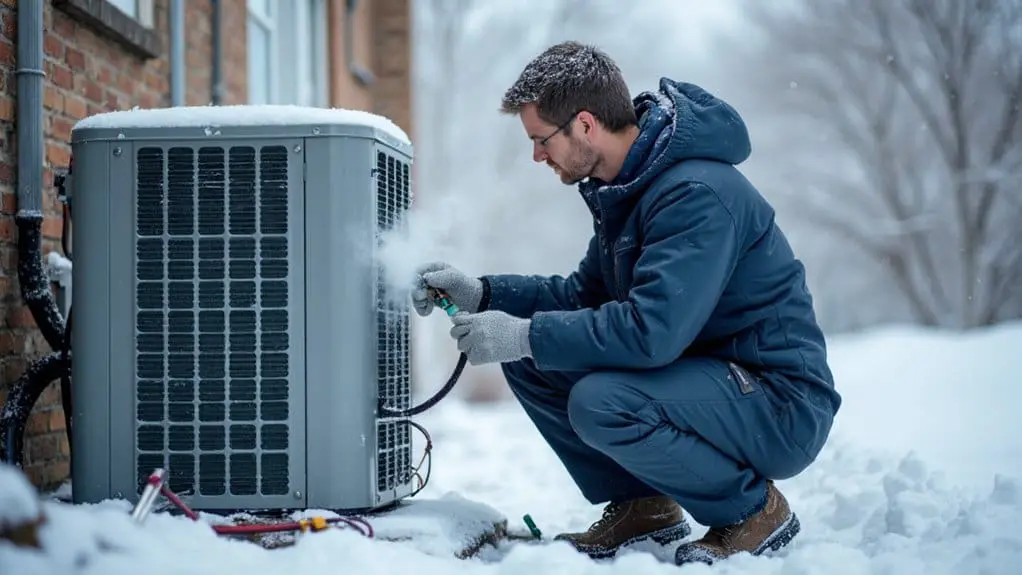
Your heat pump’s efficiency drops over 50% when temperatures hit freezing, causing ice accumulation on outdoor coils and restricting indispensable airflow. You’ll notice constant operation, abnormal grinding sounds, and lukewarm air delivery – clear indicators of refrigerant pressure issues and defrost cycle malfunctions. Ice buildup forces your system to work harder while component degradation prevents proper cycling termination. These winter-specific problems require immediate attention to prevent costly breakdowns and restore ideal heating performance throughout the cold season.
Key Takeaways
- Clear ice and snow buildup from outdoor units regularly to maintain proper airflow and prevent system overwork.
- Schedule professional repair if you notice grinding sounds, constant operation, or lukewarm air delivery during heating mode.
- Understand that heating capacity naturally drops over 50% at 0°F, so auxiliary heat activation is normal behavior.
- Monitor defrost cycles – frequent cycling or failure to melt ice indicates potential refrigerant or control system issues.
- Replace air filters and seal ductwork leaks before winter to maximize heating efficiency and reduce system strain.
Common Heat Pump Problems During Winter Weather
Winter conditions expose your heat pump to several operational challenges that can compromise system performance. Ice accumulation on your outdoor unit restricts airflow and impedes heat extraction, forcing extended defrost cycle operations that reduce overall efficiency. You’ll encounter heating capacity loss when your system can’t maintain adequate refrigerant flow through frozen coils. Cold weather exacerbates existing air leaks in ductwork, creating pressure imbalances that strain HVAC systems. Frequent thermostat adjustments disrupt continuous operation protocols, preventing your heat pump from achieving ideal efficiency ratings. Age-related component degradation becomes pronounced during winter months, with worn compressors struggling to generate sufficient heating output. Installation deficiencies manifest as inadequate refrigerant charge or improper electrical connections. Undersized units fail to meet heating demands when outdoor temperatures drop below design thresholds. Regular maintenance prevents most operational failures during peak winter performance periods.
Why Heat Pumps Struggle in Freezing Temperatures
Three fundamental thermodynamic principles explain why your heat pump’s performance degrades rapidly when outdoor temperatures approach freezing conditions. First, refrigerant pressure differentials decrease as ambient air temperature drops, reducing your system’s heat extraction capability. Second, evaporator coil efficiency diminishes below 35°F, compromising efficient heating operations. Third, ice buildup forms on outdoor coils when moisture freezes, restricting airflow and creating thermal barriers.
Your heat pump’s heating capacity drops over 50% when outdoor temperatures reach 0°F versus 47°F. This performance degradation triggers auxiliary heat activation, increasing energy consumption considerably. Ice accumulation forces defrost cycles, temporarily reversing your heating and cooling process. Cold weather operation pushes components beyond ideal parameters, reducing performance and efficiency while keeping your system running requires increased electrical input for diminished thermal output.
Signs Your Heat Pump Needs Professional Repair
Several diagnostic indicators reveal when your heat pump requires immediate professional intervention rather than basic troubleshooting measures. If your system maintains constant operation despite mild outdoor temperatures, you’re likely experiencing maintenance deficiencies, refrigerant leaks, or thermostat malfunctions. Heavy ice accumulation on outdoor units indicates defrost system failures that compromise energy efficiency during cold weather operations.
Monitor for abnormal acoustics—grinding or banging sounds signal component degradation requiring immediate HVAC repairs. Unexplained energy consumption spikes suggest mechanical deterioration or inadequate maintenance protocols. When your heat pump delivers cool or lukewarm air during constant operation, suspect refrigerant level deficiencies, compressor malfunctions, or thermostat calibration errors.
These symptoms indicate system inefficiencies that worsen without professional intervention, potentially causing complete heat pump failure during critical cold weather periods.
Understanding Heat Pump Defrost Cycles and Ice Buildup
How does your heat pump maintain consistent performance when ice threatens to compromise outdoor coil efficiency? Your heat pump system employs a defrost system that activates when sensors detect excessive buildup on the outdoor unit. The reversing valve temporarily switches operation modes, allowing your system to extract heat from indoor air and redirect it to the outdoor heat pump unit. This process melts accumulated ice formations that restrict airflow and reduce heating capacity.
While frost is normal during extreme cold conditions, frequent defrost cycles indicate potential problems. Low refrigerant levels, blocked air passages, or malfunctioning defrost controls require immediate professional diagnosis. Excessive ice buildup forces your system to work harder, drawing cold air inefficiently and compromising performance. Monitor your outdoor unit regularly, clearing snow accumulation manually when necessary to maintain ideal defrost system functionality.
When Constant Heat Pump Operation Becomes a Problem
Beyond defrost cycle irregularities, your heat pump’s constant operation presents a more complex diagnostic challenge that demands systematic troubleshooting. When your system’s running smoothly yet operates continuously, you’re facing potential heat pump issues that compromise efficient heating systems performance.
Critical indicators requiring immediate repair assessment include:
- Refrigerant depletion – Low refrigerant levels restrict heat exchange capacity, forcing continuous operation without adequate temperature achievement
- Airflow restrictions – Contaminated filters, coils, or fan assemblies impede system efficiency, causing persistent cycling
- Thermostat calibration errors – Inaccurate temperature readings trigger unnecessary runtime cycles
- Component degradation – Failing electrical systems or mechanical parts prevent proper cycling termination
If your heat pump operates effectively yet runs constantly without reaching setpoint temperatures, contact an HVAC technician immediately. Regular maintenance prevents most continuous operation scenarios, ensuring your heat pump functions ideally throughout winter conditions.
Emergency Heat vs. Heat Pump Mode: Which to Use
When your heat pump system encounters operational difficulties, understanding the distinction between emergency heat and standard heat pump mode becomes critical for maintaining both comfort and energy efficiency. Emergency heat disables your heat pump entirely, forcing your HVAC system to operate solely on backup heating elements that consume considerably more energy. You should only activate emergency heat when your heat pump is completely non-functional.
During normal cold weather operation, maintain heat pump mode and adjust your thermostat gradually by 1-2 degrees to optimize system operation. Your heat pump delivers 2.5 times more heat output per energy unit consumed compared to backup heating. Avoid switching to emergency heat unnecessarily, as this bypass eliminates the energy-efficient heat pump operation your system was designed to provide during standard temperature management.
Preventive Maintenance to Avoid Winter Breakdowns
Why do most heat pump failures occur during peak winter demand when you need reliable heating most? Inadequate preventive maintenance creates cascading system failures when components face maximum stress. You’ll prevent costly breakdowns by implementing systematic maintenance protocols before winter arrives.
Execute these critical maintenance procedures:
- Filter and component inspection – Replace air filters monthly and examine electrical connections, refrigerant lines, and defrost sensors for wear patterns
- Professional tune-ups – Schedule certified technician diagnostics to identify refrigerant leaks, calibrate thermostats, and test backup heating elements
- Outdoor unit winterization – Clear snow accumulation, trim vegetation, and verify drainage systems prevent ice formation around coils
- Building envelope optimization – Upgrade insulation and air sealing to reduce heat pump workload during extreme temperatures
Implement energy usage monitoring systems to detect performance anomalies indicating component degradation before catastrophic failures occur.
Troubleshooting Heat Pump Performance Issues
Despite thorough preventive maintenance protocols, heat pump systems exhibit performance degradation symptoms that require systematic diagnostic procedures to identify root causes. When your heat pump underperforms during cold weather, you’ll need to execute targeted troubleshooting sequences.
First, examine the outdoor unit for snow or ice accumulation that restricts airflow and compromises heat extraction efficacy. Next, verify thermostat programming isn’t causing frequent mode cycling, which degrades heating performance. Inspect installation parameters including refrigerant lines, electrical connections, and ductwork integrity.
Evaluate whether your heat pump capacity matches your climate requirements—undersized units fail in extreme cold weather conditions. Finally, assess system age and efficiency metrics. Aging components often necessitate replacement rather than continued repair efforts to restore ideal heating functionality and maintain operational reliability.
Cold Weather Heat Pump Efficiency Solutions
Modern heat pump systems require specific optimization strategies to maintain peak efficiency during extreme cold weather conditions. Your heat pump’s operational parameters must be recalibrated to address sub-zero performance degradation and maintain consistent indoor comfort throughout winter months.
Critical efficiency enhancement protocols include:
- Professional HVAC maintenance scheduling – Quarterly refrigerant level verification and coil cleaning procedures
- Building envelope optimization – Enhanced insulation R-values and extensive air sealing methodologies
- Thermostat reconfiguration – Continuous operation settings to minimize defrost cycling inefficiencies
- Geothermal system integration – Ground-source heat exchange installation for stable thermal input
Your heat pump can maintain operational efficiency down to -22°F when properly sized and configured. Implementing these cold weather optimization strategies prevents system strain while maximizing energy output ratios during extreme temperature fluctuations.
Professional Repair Services for Winter Heat Pump Problems
When winter heat pump malfunctions occur, you’ll need certified HVAC contractor professionals who possess specialized diagnostic equipment and refrigerant handling certifications to address critical system failures. Experienced heat pump technicians can identify refrigerant leaks, faulty reversing valves, and defrost cycle malfunctions that prevent your system operating efficiently during cold winter conditions.
Professional heating repair services utilize advanced testing tools to measure refrigerant pressures, electrical continuity, and airflow restrictions when your heat pump struggles with performance issues. Emergency heat pump repair interventions minimize downtime and prevent cascading component failures that occur during extended cold weather exposure.
Preventative maintenance guarantees optimal performance through refrigerant level verification, electrical connection tightening, and filter replacement protocols. Qualified technicians can restore your heat pump working capacity quickly, preventing costly emergency service calls and maintaining consistent indoor temperatures throughout winter months.
Conclusion
You’ll prevent persistent problems by performing proactive procedures and promptly pursuing professional partnerships. Don’t delay diagnosing deficient defrost cycles or detecting declining discharge temperatures. Monitor motor malfunctions, measure minimal airflow metrics, and maintain mechanical components consistently. When winter’s wrath wreaks havoc on heating systems, you can’t compromise on critical calibrations or component configurations. Execute emergency evaluations immediately if you’re experiencing erratic electrical issues or encountering excessive energy consumption patterns that indicate imminent system failure requiring immediate intervention.